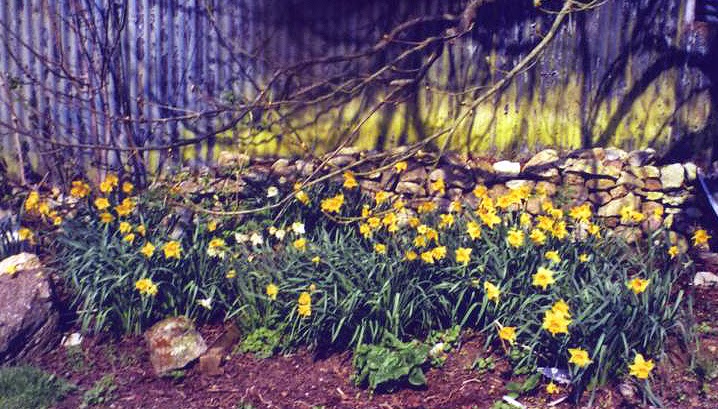
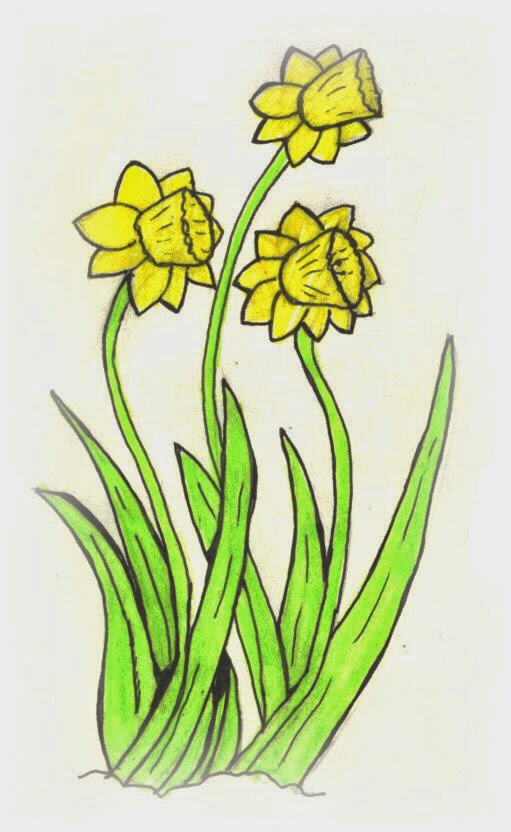
- The botanical name is Narcissus, as according to legend they are the flowers that the vain youth Narcissus turned into when he couldn't stop looking at his reflection in the lake. This name means “to benumb” as the plant has narcotic properties. It is also known as jonquil, Paperwhite, the ‘Poet’s Hower’, and in England, because of their long association with Lent, they’re known as the “Lent Lily.”
- The bulbs contain a toxin called lykorine, which is also present in small traces in the leaves. Only certain insects can eat this with impunity. Squirrels will not eat daffodil bulbs, no matter how hungry they are.
- The sap is toxic to other plants, so mixing daffodils with other flowers in a vase is not a good idea, unless the daffodils have already been soaked in water separately for 24 hours and the stems are not re-cut. There is a skin disease sometimes found in florists known as "daffodil itch".
- The UK is the world's biggest producer of daffodils. Half of the world's daffodil bulbs come from here, 10,000 tons of them, worth £7 million.
- China may well be one of our customers, as according to Feng Shui, if you can force a daffodil to flower at Chinese new year it is very lucky.
- Poultry keepers wouldn't agree. They thought the flower to be unlucky and would not have it in their homes, as they believed it would stop their hens from laying Eggs. It's also thought to be unlucky to give someone a single daffodil flower.
- The daffodil is the national symbol of Wales, along with the Leek. It is worn on St David’s day. In old Welsh, the word for daffodil and for leek are similar: (Cennin = Leek, Cenhinen Pedr = Daffodil). It is said in Wales that if you spot the first daffodil of the season, your next 12 months will be filled with wealth.
- Prince Charles is gets one daffodil each year as rent for land on the Isles of Scilly.
- The Arabs used the juice of the wild daffodil as a cure for baldness. High born ladies in medieval times used the yellow flower dye to tint their hair and Eyebrows.
Saturday, 28 March 2015
28th March: Day of the Daffodil
Sunday, 14 February 2021
15 February: The Angel of the North
On this date in 1998, the Angel of the North was installed on a hill at Low Eighton in Lamesley parish, overlooking the A1 road. Here are 10 things you might not know about it:
- The statue stands on the site of a former colliery pithead, which was re-claimed and earmarked for a sculpture in 1990.
- The Angel was created by contemporary artist Antony Gormley, and the body of the angel is said to have been based on Gormley’s own body.
- Somewhat bigger, of course. The Angel is 20 metres (66 ft) high, the height of a five story building or four double decker Buses on top of each other. It weighs 200 tonnes – the body 100 tonnes and the wings 50 tonnes each. The wings measure 54 metres (177 ft) across, which is longer than a Boeing 757 or 767 jet, and just 4 metres shorter than a jumbo jet. The wings are angled 3.5 degrees forward to suggest an embrace.
- It’s exposed location means the Angel needed some serious weather-proofing. It is made of weather resistant Cor-ten steel, containing a small amount of Copper. There is enough steel in it to make 16 double decker buses or four Chieftain tanks. 700 tonnes of concrete and 32 tonnes of reinforcing steel were used to create the foundations, and it’s anchored to bedrock 20 metres below ground level. This means the Angel can withstand winds of over 100 mph (160 km/h).
- The Red colour is caused by rust, which you might be surprised to learn, actually protects the metal underneath.
- It is Britain’s largest statue (although not the largest sculpture since the ArcelorMittal Orbit in the Queen Elizabeth Olympic Park in Stratford, London is 114.5-metres high) and the largest statue of an Angel anywhere in the world.
- As with many monumental structures, The Angel of the North received a mixed reception at first. According to Gormley, it was a tribute to a forgotten industrial age and the work of the Coal miners and steel workers of the region. He wanted it to mark the transition from an industrial to an information age; and thirdly, to serve as a focus for our evolving hopes and fears. Detractors nicknamed it The Gateshead Flasher; there were fears that it would interfere with TV reception and cause car accidents due to people gawping at it as they drove past. The latter was solved by letting trees grow at the spot where the road passes closest to the statue to hide it from view. Now, however, it has become iconic enough to be used by the long-running television detective show Vera to help establish the setting of the series in Northumberland.
- There are in existence several maquettes of the angel (a maquette being a sculptor’s equivalent of a rough sketch). Anyone lucky enough to own one is sitting on a fortune. A bronze maquette owned by Gateshead Council was valued at £1 million on Antiques Roadshow in 2008—the most valuable item ever appraised on the programme. German fashion designer Wolfgang Joop kept a life size maquette in the garden of his mansion in Potsdam, Germany until he sold it at auction at Christie's in London. It went for £3.4 million to an anonymous bidder. Another was donated to the National Gallery of Australia in 2009, and now stands in its Sculpture Garden.
- The components were transported by night in a convoy—the body on a 48-wheel trailer—from the construction site in Hartlepool, 28 miles (45 km) up the A19 road to the installation site. The journey took five hours and crowds turned out to watch.
- A Daffodil with a distinct reddish colour has been registered with the Royal Horticultural Society and officially named the ‘Angel of the North Daffodil’.
Matt Webster lives in a tower block and attends a failing school. He dreams of being a spy like James Bond. Little does he know that he is being watched by someone who can make him into even more than that – a superhero.
His first solo mission is to attend a ball at the Decembrian Embassy and discover who is planning to steal a priceless diamond. While there, he meets the mysterious Lady Antonia du Cane, and is powerfully drawn to her. It soon becomes clear, however, that Lady du Cane is not what she seems. Matt’s quest to discover who she really is almost costs him his career.
A modern day Guy Fawkes gathers a coterie around him with the aim of blowing up Parliament with a nuclear bomb. To achieve this, they need money. Lots of it. Selling the Heart of Decembria Diamond will provide more than enough. All that stands in their way is the Freedom League – but the League is beset by internal disagreements. Can the heroes put their differences aside in time to save the day?
Prime Minister Richard Miller and his wife Fiona grieve for their daughter, Yasmin, who has been missing for three years, and is presumed to be dead. Viper agent Violet Parker could hold the key to what happened to Yasmin, but Violet is accused of giving away the organisation’s secrets. She is to be executed without trial. Will she take her knowledge of what happened to Yasmin with her to her grave?
Wednesday, 1 March 2017
March 1st: Leeks
- The leeks we eat are cultivars of Allium ampeloprasum, the broadleaf wild leek. Cultivars of the leek include 'King Richard' and 'Tadorna Blue'.
- The name of the vegetable comes from the Anglo-Saxon word ‘leac’ meaning ‘herb’ or ‘plant’.
- Leek plants usually have a diameter between 2.5 and 6 centimetres (1 and 2.4 inches), and can reach 1.5 metres (5 feet) in height. The edible part is a pseudostem made from bunched up leaves. The White part, known as the shank, has been blanched as the plant pushes its way through the soil.
- Leeks have been eaten for millennia. They were eaten in Ancient Egypt - dried leeks and depictions of them on wall carvings have been found on archaeological sites. In the Bible, the leek is one of the foods listed in the Book of Numbers as one of the foods the Children of Israel missed after leaving Egypt.
- Hippocrates, the ancient Greek physician and ‘father of medicine’ prescribed the leek as a cure for nosebleeds.
- The Emperor Nero liked leeks a lot - in fact, his nickname was Porophagus (leek eater). One reason he liked to eat leeks was that he believed they were good for his singing voice (Welsh people tend to be good at singing so perhaps he was right!)
- So why is the leek a symbol of Wales? It's not even native to Wales, but was introduced to Britain by Phoenician traders in exchange for Tin. One theory is that when Briton King Cadwallader of Gwynedd was fighting the invading Saxons in a leek field, he came up with the idea that his men should wear leeks in their helmets so they wouldn't kill each other by mistake. His army won the battle. Another theory is that leeks were the only thing St. David would eat during a fast, as he believed it to be a healthy and virtuous plant.
- The leek appeared on the coronation gown of Elizabeth II, designed by Norman Hartnell. It was there as a symbol of Wales. Hartnell would have preferred to use the other symbol of Wales, the Daffodil, because daffodils are prettier, but he was told he must use the leek.
- Extraordinary qualities were claimed for leeks in St. David's time. People back then said leeks were high in fibre, good for purging the Blood, keeping colds at bay and healing wounds. It was even said that if a young woman sleeps with one under her pillow she will dream of her future husband. Today we know that leeks are a rich source of dietary fibres, vitamins of the B-group, vitamins A, C and K and minerals such as Potassium, Iron, calcium and magnesium.
- Finally, Shakespeare mentions leeks, too. In his play Henry V, Henry tells the Welsh officer Fluellen that he is wearing a leek “for I am Welsh, you know, good countryman.”
Related Posts
Wales
Daffodil
Dragons
NEW!!
Sweet Karma
My latest short story collection: murder and mayhem along with moving statues, Ancient Egyptian magic pebbles, a World War II evacuee's diary and a bathtub full of marshmallows.
Paperback Createspace or Amazon
Wednesday, 6 April 2022
7 April
10 weird and wonderful things which happened on 7 April:
- Born on this date in 1770 was William Wordsworth, romantic poet, England's Poet Laureate from 1843 until his death in 1850. He wrote the poem, The Daffodils, which begins: "I wandered lonely as a cloud: That floats on high o'er vales and hills, When all at once I saw a crowd, A host of golden Daffodils."
- In 1739, the legendary Highwayman Dick Turpin was executed at the age of 32. Richard Turpin was actually a violent criminal who committed offences such as Deer stealing, burglary, highway robbery and murder before being executed in York for the murder of an innkeeper. It is said that as a last gesture he threw himself off the ladder ahead of the official “drop”. After his death, he was romanticised as the dashing and heroic highwayman.
- This date in 1928 saw the death of Alexander Bogdanov, a 54 year old Russian scientist and author who believed that transfusions of Blood from young people would grant him eternal youth. He carried out experiments on himself, and claimed that his eyesight improved and that he was no longer going bald. He didn't know about blood borne diseases, however, and died of malaria and TB contracted from the blood of his last donor.
- On this date in 1996, a wedding took place at Lopburi Zoo, Bangkok. The bride and groom were Mike and Susu, a pair of Orangutans.
- In 1933, the 18th, or Prohibition, amendment was repealed in the USA. Passed in 1920, this amendment made it illegal to manufacture, sell or transport alcoholic drinks. Intended to reduce crime, corruption and other social problems, the measure had became very unpopular. The state of Oklahoma, however, didn't end prohibition until this date in 1959.
- In 1853, chloroform was used as an anaesthetic on Queen Victoria, during the birth of her eighth child, Prince Leopold.
- The first Matches were sold on this date in 1827. Marketed as "friction lights", invented by John Walker, a chemist in Stockton-on-Tees, Co. Durham, the first known purchaser was a local solicitor who paid one shilling (5p) for 100 matches and a further 2d (1p) for the tin tube to keep them in.
- In 1996 Poole Town soccer team ended a 39 match run of losses by drawing against Barnsley 0-0. They narrowly missed earning an entry in the Guinness Book of Records for being the worst team ever. One more loss would have done it.
- In 1832, Joseph Thompson, a farmer, went to Carlisle to sell his wife. They had both agreed to separate. A large crowd gathered as he offered her for 50 shillings (£2.50). After an hour, the price was knocked down to 20 shillings (£1), with a Newfoundland dog thrown in. The practice of wife selling, although illegal in Britain, was not unknown in rural areas.
- In 1943, LSD (lysergic acid diethylamide) was first synthesised by Albert Hoffman in his Swiss laboratory. On the same date in 1956, Humphrey Osmond coined the word "psychedelic" to describe the effects of LSD and similar drugs.
The Power of Love
Willow believes in crystal healing, cosmic ordering and the significance of chance encounters. She believes there's a spiritual explanation for everything. Except she struggles to find a reason why she can turn herself into mist and create a wave of energy which can slam a would-be mugger into a wall. Or why the love of her life left her for a mysterious woman in sunglasses, who then disappeared without trace.
A chance encounter with Firebolt, leader of the Freedom League superhero team, in a Glastonbury coffee shop, does turn out to be significant. He offers her a new start and the chance to use her powers for good.
Servant is a Christian who has joined the Freedom League in order to use his teleporting power to serve God. He and Willow clash from the start, yet they are drawn inexorably to one another.
When Willow leaves the team abruptly for reasons unknown, Servant knows he must put her out of his mind and find a nice Christian girl to settle down with. He is about to propose to devout and straight-laced Ruth, when Willow returns and turns his entire world upside down.
Available from Amazon:
Paperback
Saturday, 23 May 2015
23rd May: Eurovision Song Contest
- The first contest was held in May 1956. It took place in Switzerland with seven countries taking part and each performing two songs. We don't know how anybody voted because no recording of the event exists, but we do know that Switzerland won. Eurovision means a contest which is broadcast on the Eurovision television network, which is why countries like Israel and Morocco can take part even though they are not technically in Europe. In 2015, Australia is taking part as a one off guest contestant.
- The contest was originally intended to unite countries through song, although politics tends to creep in with traditional allies voting for each other. Some countries refuse to take part because Israel does, or because they have been told they cannot block out the Israeli song. In 1978, Jordanian television showed a bunch of Daffodils when the Israeli entry won, and claimed that Belgium, who came second, had won.
- There are a number of rules. Songs can be no longer than 3 minutes and only six people are allowed on stage during the performance, including dancers. Until 1971, groups of more than three were not allowed - if that had not changed, neither ABBA or Buck's Fizz could have even entered. Instrumental pieces are not allowed, and animals are not allowed on stage. Countries are free to enter singers of any nationality. The songwriters are supposed to be natives but this isn't strictly enforced.
- Ireland holds the record for the most wins (seven), with Luxembourg, France, Sweden and the United Kingdom hot on their heels with five wins each. Eurovision is a colourful spectacle, but the most winning colour to be worn by contestants is white. Seven of the winners wore white, more than any other colour. The language most likely to win is English - songs performed in English have won 26 times. In 1969 there was a tie between France, the Netherlands, Spain and the United Kingdom.
- The least successful country is Norway, who have come last eleven times. They have won more recently than the UK have, though. Portugal, despite competing since 1964, have yet to enter a winning song. Other nations who have been competing for over 20 years and are still waiting for a win are Malta, Cyprus and Iceland. No country has yet won after performing second in the line-up.
- The contest always begins with the fanfare Prelude To Te Deum by Marc-Antoine Charpentier, which has become known as the "Eurovision Anthem".
- The youngest ever entrant was Sandra Kim from Belgium who won in 1986 at just 13. The oldest was Emil Ramsauer, 95, from Switzerland, not Englebert Humperdinck, 78.
- In 1974, the UK did not score ABBA any points.
- Some Eurovision firsts - the UK's first win was in 1967 (Sandie Shaw singing Puppet on a String. She confessed later that she hated the song from the moment she first heard it. She said it was "sexist drivel and a cuckoo-clock tune"). The first contest to be broadcast in colour was in 1968 from the Royal Albert Hall. The first black contestant was the Netherland's Millie Scott in 1966. The only black winner so far is Dave Benton (one half of Estonia's Tanel & Dave in 2001).
- Some of the wackiest entries: Spain's La La La, which won in 1968, contained no fewer than 138 'las'. Norway's 1980 song was about the construction of a hydro-electric power station. France's 2014 song was about a man trying to grow a moustache and in 2013 Sweden's Petra Mede sang about Ikea, Abba, The Girl with the Dragon Tattoo, recycling and the fashion retailer H&M.
My Books:
Death and Faxes
Several women have been found murdered - it looks like the work of a ruthless serial killer. Psychic medium Maggie Flynn is one of the resources DI Jamie Swan has come to value in such cases - but Maggie is dead, leaving him with only the telephone number of the woman she saw as her successor, her granddaughter, Tabitha Drake.Paperback - CreateSpace or Amazon
Or get the E-book: Amazon Kindle (Where you can use the "Look Inside" function and read the first few pages for free!)
Glastonbury Swan
Saturday, 18 February 2023
19 February: EastEnders
The first episode of EastEnders was broadcast on this date in 1985. 10 things you might not know about EastEnders:
- Creators Julia Smith and Tony Holland considered a number of potential titles for the show, which included Square Dance, Round The Square, E8 and London Pride. It was only when Julia Smith started ringing round agents and asked “Do you have any real East Enders on your books?” that the show got its name.
- Both Julia Smith and Tony Holland were actually born in East London, and Walford, the fictitious area of London the show is set in is actually a portmanteau of the areas they came from: Walthamstow and Stratford. The postcode, E20, was also fictitious, at least to begin with. Back then, the highest “E” postcode in London was E18 (South Woodford). E20 sounded better than E19. However, in 2011 the Olympic Park was given the postcode E20 so it’s no longer fake. The real-life inspiration for Albert Square is a place called Fassett Square in the Dalston area of Hackney.
- Actor Adam Woodyatt (Ian Beale) has been a part of the show since the very first episode, when he was a teenager, making him the show’s longest-serving character. He’s also been a prime suspect in three murders over the years.
- The longest serving costume is Dot Cotton’s Christmas dress. She wore the same dress every single Christmas. It is the oldest costume in the entire EastEnders cast wardrobe – it’s almost as old as the show itself. Most of Dot’s other outfits came from charity shops.
- There’s nothing behind the door to the Queen Vic aside from a corner bar which is visible in shot. Scenes set in the pub are filmed in a studio elsewhere. Most of the drinks are fake, too. Vodka is actually water; Whiskey is water and burnt Sugar; Wine wine is diluted Apple juice. The one exception is the Beer. The beer in the pumps is real.
- Every episode is 27 minutes and 15 seconds long.
- The highest viewed episode of any soap in UK television history was the Christmas Day episode of EastEnders in 1986. The one where Dirty Den handed divorce papers to Angie.
- Fictional tube station Walford East is located between Bow Road and West Ham, on the Hammersmith & City and District lines. The trains, however, are as fake as the Queen Vic vodka, having been animated with CGI since 2010.
- Also fake are the leaves on the trees and Daffodils in spring. Because episodes are filmed up to 12 weeks in advance fake leaves are added to trees and plastic daffodils placed in the ground to make it look like spring in the middle of winter.
- Barbara Windsor was actually the fourth choice to play landlady Peggy Mitchell. Emma Bunton auditioned for the role of Bianca before becoming Baby Spice.
Character birthday
Crusher: Power armour wearer and member of Combat Team Delta. Former stunt double who first wore his armour for his role in a superhero movie. Has not yet appeared in a published story.
Thursday, 5 March 2020
6 March: Narcissus Day
- Narcissus, in Greek mythology, was a hunter from Laconia who loved beautiful things. Since he was beautiful, that included himself, and he is usually pictured gazing at his own reflection in a pool.
- His father was the river god Cephissus and his mother was the nymph Liriope.
- Because he was so beautiful, people had a tendency to fall in love with him, and he had a tendency to spurn them. In one famous story, a nymph called Echo fell for him and began following him around. Sensing someone was there, Narcissus called out, "Who's there?" and Echo responded by repeating, "Who's there?" Eventually, she did reveal herself and declare her love, but Narcissus told her to go away. Heartbroken, she spent the rest of her life wandering in lonely glens until all that was left of her was her voice, repeating anything anyone said.
- It wasn't only women who fell for Narcissus. In another story, a young man called Ameinias fell for him, too. Narcissus wasn't interested in men, any more than he was interested in Echo, and spurned him, too, giving him a sword so he could kill himself on Narcissus's doorstep.
- Nemesis, the goddess of revenge, decided Narcissus needed to be punished for such heartless behaviour. She lured him to a pool, where he saw his own reflection and fell in love with it. He soon worked out his love was never going to be reciprocated, but could only sit and gaze and himself, until he turned into a flower.
- His name has found its way into modern language. Narcissism is a term used for people who are overly obsessed with themselves.
- Its also the name of a genus of flowers which includes the Daffodil. It's not known whether the myth gave the name to the flower, or the other way round, or whether the two are completely unrelated.
- A second century Greek writer, Pausanias, wrote a new take on the Narcissus story which has him fall in love with his Twin sister rather than himself. Obviously, he can't have her either, and that story ends the same way, with him turning into a flower.
- The myth has inspired any number of modern day writers including Paolo Coelho, Oscar Wilde, William Faulkner, Herman Hesse, Herman Melville and A. E, Housman. JK Rowling named a Harry Potter character after him, too - Narcissa Malfoy.
- He's also inspired many artists to paint or sculpt him. Caravaggio, Turner and Salvador Dali among them.
My Books
(for more details and buying options Click Here)
The Ultraheroes series
Golden Thread
Tabitha Drake series
Short story collections
Sunday, 1 March 2020
2 March: Facts about March
- March was the first month of the Roman calendar and was named after Mars, the Roman god of war.
- Birthstones for people born in March are aquamarine and bloodstone, which both symbolise courage.
- The birth flower for people born in March is the Daffodil.
- Native American tribes named the moons of months after things they observed in nature at the time of year. Native American names for the moon of March include Buffalo Dropping their Calves, Eyes are Sore From Bright Snow Moon, Strawberry Moon, Little Frog Moon and Moon When the Leaves Break Forth.
- The expression, "mad as a March Hare" comes from the fact that March is the rutting season for these animals.
- In weather lore, March is said to come in like a Lion and go out like a lamb - meaning that the weather is rough at the beginning of the month and calmer towards the end. Farmers liked the March winds as they'd dry out the fields ready for planting. A wet March foretells a poor harvest.
- Couples who marry in March may never settle in one place. "Married when March winds shrill and roar, your home will be on a distant shore", says one folk saying. Another is "If you wed when March winds blow, joy and sorrow both you'll know."
- Observances and awareness campaigns which happen in March include Cataracts, caffeine, colorectal cancer, ethics, foot health, frozen food, hamburgers and pickles, listening, music in schools, chronic fatigue syndrome, eye donors, flour, frozen food, haemophilia, kidneys, Peanuts, poetry, potholes, Umbrellas and women's history.
- In the Bulgarian language, March is the only month with a feminine name.
- It is said to be unlucky to start a journey or begin important work during the last quarter of the Moon in March.