Showing posts with label Groups. Show all posts

Saturday, 27 May 2023

28 May: Amnesty International

Today is Amnesty International Day. 10 things you might not know about Amnesty International:

  1. It was founded in 1961 by the British lawyer Peter Benenson, who had previously been a founding member of the UK law reform organisation JUSTICE.

  2. By his own account, he was inspired to do so when he read a report about two Portuguese students who’d been sentenced to seven years of imprisonment in Portugal for "having drunk a toast to liberty". There’s no concrete proof that happened, however, and nobody has been able to track down the article he was reading. That said, it’s probably true someone had been imprisoned and that Benenson believed it was unjust, even if the finer details got altered through repeated re-tellings.

  3. The logo is a lit Candle surrounded by Barbed Wire. This was inspired by a Chinese proverb, “It is better to light a Light than to curse the Darkness”. The logo was designed by Diana Redhouse in 1963 as Amnesty's first Christmas card.

  4. The six key areas that Amnesty works in are: The rights of women, children, indigenous peoples and minorities; Ending torture; Abolition of the death penalty; Rights of refugees; Rights of prisoners of conscience and Protection of human dignity.

  5. In 1977, it was awarded the Nobel Peace Prize.

  6. It is independent of all governments, political interests, religions and financial interests. On its website, Amnesty states, “We neither seek nor accept any funds for human rights research from governments or political parties and we accept support only from businesses that have been carefully vetted.”

  7. It is funded by donations and has also organised benefit concerts and comedy shows to raise funds and awareness. These include: A Conspiracy of Hope, a short tour of six concerts which took place in the USA in June 1986; and The Secret Policeman’s Ball which was organised by Monty Python’s John Cleese in 1976. People who have participated include: U2, Sting, Bryan Adams, Peter Gabriel, Lou Reed, Joan Baez, Rowan Atkinson, Russell Brand, Kristen Wiig, Duran Duran, Phil Collins and Kate Bush.

  8. Amnesty maintains a list of “Films That Open Eyes”, both fictional and documentaries which highlight human rights and oppression. These include: 12 Years a Slave, Apocalypse Now, Billy Elliot, Brokeback Mountain, Dead Man Walking, Gandhi, The Help, Milk, Osama, The Pianist and Schindler’s List.

  9. At time of writing the Secretary-General is Agnès Callamard and the organisation is based in the UK.

  10. I’ll end with a quote from Peter Benenson: “Only when the last prisoner of conscience has been freed, when the last torture chamber has been closed, when the United Nations Universal Declaration of Human Rights is a reality for the world’s people, will our work be done.”


Character birthday

Thundercloud, a 19th century Native American who was accidentally transported to our time when the Galactic Force the Constellations were experimenting with the creation of wormholes so that people stranded here from the Infinitus dimension could go home. On Constellation Station Thundercloud met McGregor, a Scottish nationalist from the 18th century. They bonded over hatred for their respective enemies. Thundercloud had no interest on remaining with the Constellations as they had also rescued Indrus, a member of a tribe which were Thundercloud’s sworn enemies. Thundercloud and McGregor demanded to be returned to Earth. It had not proved possible to create a wormhole back to their own times, so they were relocated into present day England. As McGregor still had his sword, Thundercloud demanded he be given a weapon to defend himself with. He was offered a choice and selected the lightning ball. On Earth, the two met and joined forces with the Desperadoes. See Over the Rainbow.


Over the Rainbow


'We're not in Trinity anymore,' says Leonard Marx, quoting a line from an old Innovian  movie. The moon is different; the planes flying overhead are different. Nobody has any idea where they are or if it's possible to get home

In this strange new world, people from the highly technical Innovia and the less advanced Classica must co-operate in order to survive. In addition, travel through the inter-dimensional wormhole has given some people unusual and unexpected powers.

Innovia mourns the loss of its superhero, Power Blaster, last seen carrying a nuclear bomb to the upper atmosphere away from the inhabited Bird Island. They don't believe he could possibly have survived.  Power Blaster has survived, but is close to death and stranded in the new dimension. He is nursed back to health by a Classican woman, Elena. She has no idea who he is, only that she is falling in love with the handsome stranger.  

Shanna sets out to discover what happened to Nathan Tate, who didn't return from his hiking holiday, not knowing her life is about to be turned inside out and upside down. 

Meanwhile, Desi Troyes, the man responsible for the catastrophe, is at large on the new world, plotting how he can transfer his plans for world domination to the planet he now finds himself on - Earth. 


Available from Amazon and Amazon Kindle


Tuesday, 3 November 2020

4 November: UNESCO

On this date in 1946, UNESCO was formed. 10 things you may not know about it:

  1. What does UNESCO stand for? United Nations Educational, Scientific and Cultural Organization.
  2. Aside from designating World Heritage Sites, what does it do? According to its website, it seeks to build peace through international cooperation in Education, the Sciences and Culture. Making sure everyone has access to a quality education is one of its key aims, along with promoting diversity, preserving cultural heritage, developing scientific programmes and encouraging co-operation between nations.
  3. UNESCO as we know it was formed in 1946, but its roots lie in much earlier initiatives dating back to 1921, when the United Nations set up a Commission to look at the feasibility of intellectual co-operation between nations. Albert Einstein and Marie Curie were members.
  4. During the Second World War, a group called the Conference of Allied Ministers of Education (CAME) began meetings in London with the aim of setting up an organisation to promote education and culture, which ultimately led to the formation of UNESCO in 1946.
  5. UNESCO has instigated a number of international observance days. The best known are World AIDS Day on 1 December and International Women's Day on 8 March. There’s not room here to list them all but they include World Radio Day (13 February), World Poetry Day (21 March), International Jazz Day (30 April), World Oceans Day (8 June), International Youth Day (12 August), International Literacy Day (8 September), World Statistics Day (20 October) and International Men’s Day (19 November).
  6. UNESCO awards 22 prizes in education, science, culture and peace. They include awards for woman in science, literacy, promoting human rights, ethics in science and Arab culture.
  7. As of January 2019, UNESCO has 193 member states and 11 associate members. Palestine joined in 2011 which resulted in the USA withdrawing its funding and leaving altogether in 2018 (Hardly in the spirit of things, is it, America?) and Israel left in 2019 after being a member for 69 years, claiming that UNESCO “continually rewrites history” to Israel’s detriment.
  8. A World Heritage Site is a landmark or area designated by UNESCO for having cultural, historical, scientific or other form of significance, and thus given legal protection. To be selected, a World Heritage Site must be a unique landmark which is geographically and historically identifiable with special cultural or physical significance. They include ancient ruins or historical structures, buildings, cities, deserts, forests, islands, lakes, monuments, mountains, or wilderness areas. At time of writing there are 1,121 of them spread over 167 countries. The countries with the most are Italy and China, with 55 each, and Spain with 48. The idea of World Heritage sites arose in 1954 when the proposed Aswan High Dam in Egypt was going to result in cultural treasures of Nubia being submerged by the resulting reservoir. UNESCO stepped in to help salvage as much as possible, moving several temples to higher ground. The first heritage site to be designated, in 1978, was the Galapagos Islands.
  9. There’s also a list of intangible cultural heritage which includes languages, crafts and music. This list includes the Tango in Argentina, flamenco in Spain, horsemanship at the Spanish Riding School in Vienna, falconry, Arabic and Turkish coffee, Belgian Beer, Cambodian ballet, Chinese calligraphy, dry stone walling, the Mediterranean diet, Jamaican Reggae music, Portuguese Fado music, and many more.
  10. There are two more lists which are proposed. One to focus on movable heritage such as paintings or artifacts. The Mona Lisa and Michaelangelo’s David might be examples of movable heritage. The other proposed list is of living species, such as komodo dragons, Pandas and Bald eagles.


Killing Me Softly

Sebastian Garrett is an assassin. It wasn’t his first choice of vocation, but nonetheless, he’s good at it, and can be relied upon to get the job done. He’s on top of his game.

Until he is contracted to kill Princess Helena of Galorvia. She is not just any princess. Sebastian doesn’t bargain on his intended victim being a super-heroine who gives as good as she gets. Only his own genetic variant power saves him from becoming the victim, instead of Helena. 

Fate has another surprise in store. Sebastian was not expecting to fall in love with her.

Available on Amazon:

Paperback


Sunday, 13 September 2020

15 September: Greenpeace

Today is Greenpeace Day commemorating the date Greenpeace was founded in 1971. 10 things you might not know about Greenpeace.


  1. First of all, what is it? Greenpeace is an international environmental group with offices in 55 countries worldwide and 2.8 million supporters.
  2. The group started out as a group calling themselves the "Don't Make a Wave Committee" in Vancouver in 1969. The group formed, initially, to "bear witness" to U.S. underground nuclear testing at Amchitka, an island off Alaska. The group were motivated by a concern for the wildlife living on the island, and opposition to nuclear weapons.
  3. The group set out in a boat called the Phyllis Cormack. They were intercepted before reaching the island but created some interest and the United States ended nuclear testing on the island later that year.
  4. It was in 1971 that they changed their name to Greenpeace. There’s a story about how the name originated, which may or may not be true. The person who coined the name was Bill Darnell. Many of the people involved in the early days were hippies and after one meeting, one of them departed afterwards with a two finger salute and said, “Peace!” Bill realised that Green and Peace would combine to make a punchy new name which reflected both their concerns for wildlife and their anti-nukes stance. "Let's make it a Green Peace. And we all went Ommmmmmmm," Bill reports on the organisation’s website.
  5. In 1972 they began protesting against French atmospheric nuclear tests in the Pacific, asking for yacht owners to help. One of those who came forwards was David McTaggart, a former entrepreneur from Canada who at the age of 40, and given it all up in order to sail round the world in his 38 foot yacht, the Vega, in order to find himself. At first, he was more annoyed about the French government closing off part of the Pacific to shipping than about nuclear testing. McTaggart managed to evade the navies chasing him down and got to within a few miles of the test site and dared the French to kill him. They didn’t – they rammed his yacht and towed it away with a minesweeper, claiming they were rescuing him. Undeterred, McTaggart protested again a year later and this time he was boarded and beaten up by French commandos, who tried to claim it had been an accident or that McTaggart had staged his own injuries, but photographs taken by a crew mate exposed the lie. Soon after, France abandoned atmospheric testing and moved its nuclear testing underground.
  6. The original Rainbow Warrior flagship was launched in 1978. It was a 40-metre (130 ft), former fishing trawler named after a book called Warriors of the Rainbow, which was a Christian tract published in 1962, but misinterpreted by some as an ancient Native American prophecy, which states that a time of crisis will come to the Earth, and when it does, people of different races will come together to save the planet. The Rainbow represents the range of different skin colours – RedWhiteYellow and Black. In 1985 the ship was bombed by the French government while docked in AucklandNew Zealand.
  7. A second Rainbow Warrior was commissioned in 1989. That one got in to trouble when it ran aground on a Coral reef and Greenpeace was fined for damaging the reef. They paid up but claimed they’d been given out of date charts. This ship retired in 2011 and was replaced by a third ship called Rainbow Warrior, which is still in use.
  8. They had their own Boaty McBoatface moment. They once held a contest online to name a humpback Whale, asking people to suggest names and then vote for their favourite. Aiko, Mira, Aurora and Libertad were among the suggestions, but the runaway winner was “Mr. Splashy Pants” with over 78% of the vote.
  9. At time of writing the directors of Greenpeace International are Bunny McDiarmid and Jennifer Morgan and the current Chair of the Board is Ana Toni.
  10. Today, the aims of the group include fighting climate change, protecting biodiversity, promoting renewable energy and global disarmament.


Killing Me Softly

Sebastian Garrett is an assassin. It wasn’t his first choice of vocation, but nonetheless, he’s good at it, and can be relied upon to get the job done. He’s on top of his game.

Until he is contracted to kill Princess Helena of Galorvia. She is not just any princess. Sebastian doesn’t bargain on his intended victim being a super-heroine who gives as good as she gets. Only his own genetic variant power saves him from becoming the victim, instead of Helena. 

Fate has another surprise in store. Sebastian was not expecting to fall in love with her.

Available on Amazon:

Paperback


Monday, 4 March 2019

4th March: The Royal National Lifeboat Institution

The Royal National Lifeboat Institution (RNLI) was founded on this date in 1824. Some facts about one of Britain's biggest charities.

  1. What is it and what does it do? It's a registered charity in the United Kingdom whose function is to save lives at sea. It receives no government funding - it depends entirely on donations and legacies. Queen Elizabeth II is its Patron.
  2. It was founded by Sir William Hillary, who lived on the Isle of Man and became aware that ships were often wrecked around the Manx coast. He drew up a plan for a national lifeboat service. He first pitched it to the Admiralty, but they showed little interest. He turned instead to philanthropic members of London society and members of parliament to make his plans a reality.
  3. The organisation was initially called the National Institution for the Preservation of Life from Shipwreck. It became the Royal National Lifeboat Institution in 1849 after Prince Albert began supporting it.
  4. The organisation's Flag was designed by Leonora Preston in 1884 after a lifeboat crew in Ramsgate rescued her brother.
  5. The RNLI was the first charity to organise a street collection, in 1891, in Manchester. The collection was orgnaised after 27 lifeboatmen were lost.
  6. At time of writing there are 233 lifeboat stations around the coast of the UK and four on the River Thames. There are over 330 lifeboats and about 4,800 lifeboat crewmembers.
  7. Since the RNLI was founded, its lifeboats have saved more than 137,000 lives. Lifeboats launch several thousand times a year (7,656 times in 2004, saving 433 lives). The busiest lifeboat station is Tower Lifeboat Station on the River Thames.
  8. In the early days of the service, it was considered bad luck for women to crew lifeboats, although they would help with the launch and recovery of the boats. Today, about 8% of lifeboat crews are women. The first woman crew member was Elizabeth Hostvedt in 1969.
  9. The RLNI does not get any of its income from the salvage of shipwrecks. While there is no legal reason why they couldn't, they don't, because they are there to save lives. If they tow a boat to safety, they will not ask for a salvage fee, because charging a fee might discourage people from calling them (however, if the people rescued want to make a voluntary donation to say thank you, they can, of course). The RNLI were criticised when they refused to launch a lifeboat to help recover an unmanned fishing boat which had run aground, but said this was because no lives were at risk and the charity wasn't a salvage firm.
  10. It's a challenging and often dangerous job - over 600 people have lost their lives while serving as lifeboat crew over the years. Their names are inscribed on the RNLI Memorial sculpture at RNLI HQ, in Poole.

I write fiction, too! My characters include some British superheroes and a psychic detective. You never know, your new favourite could be here! You won't know unless you look...


    Browse other topics I've covered in this blog - HERE.

    Like my Facebook page for news of Topical Ten posts, posts on my writing blog, and news of upcoming publications.

    Friday, 4 August 2017

    4th August: The Red Cross

    On this date in 1870 the British Red Cross was founded. Here are ten things you possibly didn't know about the Red Cross organisation.

    Red Cross Stamp
    1. The Red Cross concept had already been around a number of years before this. Since 1859, in fact, when a Swiss businessman called Jean Henri Dunant went looking for French Emperor Napoleon III, in the hope of getting a meeting and persuading the emperor to help with a business venture. Dunant didn't find Napoleon, but he did stumble upon the Battle of Solferino, in which 40,000 troops were killed or wounded in a single day. Appalled by the conditions and lack of care for the wounded, he pitched in to help by organising volunteers to bring food and Water to the wounded, to treat their injuries and to write letters to their families. He later wrote a book about it and how awful it was, ending with an appeal for “permanent societies of volunteers who in time of war would give help to the wounded without regard for their nationality.” The following year, it happened.
    2. The organisation took as its emblem a reverse of the Swiss Flag, ie a red cross on a White background. However, some countries weren't happy with that because they saw the cross as a Christian emblem. Before the Ottoman Empire went to war with Russia in 1877, it agreed to set up a national Red Cross society with one condition - that they could use a red crescent instead of a cross. Russia agreed to recognise that emblem during the conflict; although it was 1929 before the crescent symbol was incorporated into the Geneva Conventions. Today, the national societies of more than 30 Islamic nations use the red crescent.
    3. Even so, there were still nations which objected to either symbol on religious grounds. Israel, for example, wanted to get a red Star of David accepted as a symbol. While that hasn't happened, there is a third symbol, recognised by the Geneva Convention in 2005 - a red crystal, or diamond. The Israeli equivalent of the Red Cross, Magen David Adom, uses a Star of David at home but adopted the crystal for use abroad, although it may have the Star of David inside it. There's even a fourth symbol, the red Lion and Sun, which was used in Iran before the 1979 Iranian Revolution.
    4. You'd think Florence Nightingale would think the Red Cross was a great idea, but in fact, she didn't, at least not at first. She thought that such an organisation absolved governments from their responsibility to take care of their wounded and make war easier. She even wrote in a private letter to a friend essentially that what would someone from Geneva, which had never seen a war, possibly know about such things? However, later on, she changed her mind and even joined the British Red Cross ladies’ committee.
    5. The American Red Cross was founded in 1881 by Clara Barton, who had nursed wounded troops in the US Civil War. She also helped locate thousands of missing men, earning the nickname “Angel of the Battlefield.” On a visit to Europe, she found out about the Red Cross and went home to lobby for the USA to sign up. She led the American Red Cross until she retired at the age of 83.
    6. In Britain, the cause was taken up by Colonel Loyd-Lindsay (later Lord Wantage of Lockinge) in 1870. On 4 August 1870 a public meeting was held in London and a resolution passed that "a National Society be formed in this country for aiding sick and wounded soldiers in time of war and that the said Society be formed upon the Rules laid down by the Geneva Convention of 1864".
    7. 12 countries signed up in 1864. Now 189 countries have a Red Cross or equivalent organisation. The international network now has more than 97 million staff, volunteers, and supporters. Some of them in the past have been quite famous. Agatha Christie was a voluntary aid detachment for the Red Cross during both world wars. Rudyard Kipling helped set up a library to supply books and magazines to wounded soldiers during WWI. E.M. Forster was another writer and a pacifist who, when deemed fit to be called up, chose to work as a Red Cross volunteer instead. He worked in Alexandria, Egypt, interviewing wounded soldiers trying to find out what might have happened to some of the soldiers who'd been reported missing.
    8. Modern day supporters include Stephen Fry, Jamie Oliver, Grayson Perry, film director Ken Loach, Eddie Izzard, Simon Pegg, Vivienne Westwood, Angela Rippon, Victoria and David Beckham and Amanda Holden. These celebrities have donated money, clothing, and/or their time to help publicise appeals. The British Red Cross also claims to have one volunteer with webbed feet. No, not a duck - a Newfoundland Dog called Loki, who helps rescue people from floods.
    9. The Red Cross has won more Nobel Peace Prizes than anyone. The organisation has won three Nobel Peace Prizes, in 1917, 1944 and 1963.
    10. The Red Cross doesn't just work in war zones. It helps out with natural disasters and emergencies at home. In 1921 the British Red Cross established the first Blood transfusion service in the UK, and continued to provide help with the blood transfusion service in an ancillary specialist role until 1987. It also provided volunteers to nurse people in the Spanish flu epidemic in 1918/19. Look at their website now and the main appeal (at time of writing) is for a fund to help the victims of the recent terrorist attacks in Manchester and London. (http://www.redcross.org.uk/).


    Browse other topics I've covered in this blog - HERE.

    Like my Facebook page for news of Topical Ten posts posts on my writing blog, a weekly writing quote and news of upcoming publications

    Thursday, 23 June 2016

    23rd June: The European Union

    Today is the EU Referendum, where Britain decides whether to remain in the European Union or leave. This post isn't about whether we should stay or go but is ten facts about the EU generally - but who knows, I might help a last minute waverer make up their mind!

    1. There are 28 member states, between them accounting for over 7% of the world's population.
    2. The six founding states were BelgiumFrance, West GermanyItalyLuxembourg, and the Netherlands. The most recent country to join was Croatia in July 2013. AlbaniaIcelandMacedoniaMontenegroSerbia, and Turkey are all on the road to membership. Iceland suspended negotiations in 2013. Bosnia and Herzegovina and Kosovo have applied to be considered.
    3. To become a member, a country must meet the Copenhagen criteria, defined at the 1993 meeting of the European Council in Copenhagen. These require a stable democracy that respects human rights and the rule of law; a functioning market economy; and the acceptance of the obligations of membership, including EU law.
    4. The EU has 24 official languages. European parliament debates are translated into all of them. There are also six semi-official languages, which people can use in correspondence and major treaties are translated into. These are Catalan, Galician, Basque, Scottish Gaelic and Welsh. The most widely spoken mother tongue in the EU is German. 16% of the population are native German speakers. When languages other than the mother tongue are included, the most widely spoken language is English.
    5. There are 751 members of the European Parliament Germany, as the most populous country has the most representatives - 99.
    6. No member state has ever left the EU (so far) although Greenland (an autonomous province of Denmark) withdrew in 1985. (Although at the time of this update, the UK had proved that power-hungry politicians, greedy capitalists, racist thugs and arrogant, ignorant people who seem incapable of using apostrophes and capital letters, and believe any crap they see painted on the side of a bus, slightly outnumber the intelligent and sensible people, that its election system is so rubbish that someone who only gets 46% of the vote can still win and force through any policy they want, no questions asked.)
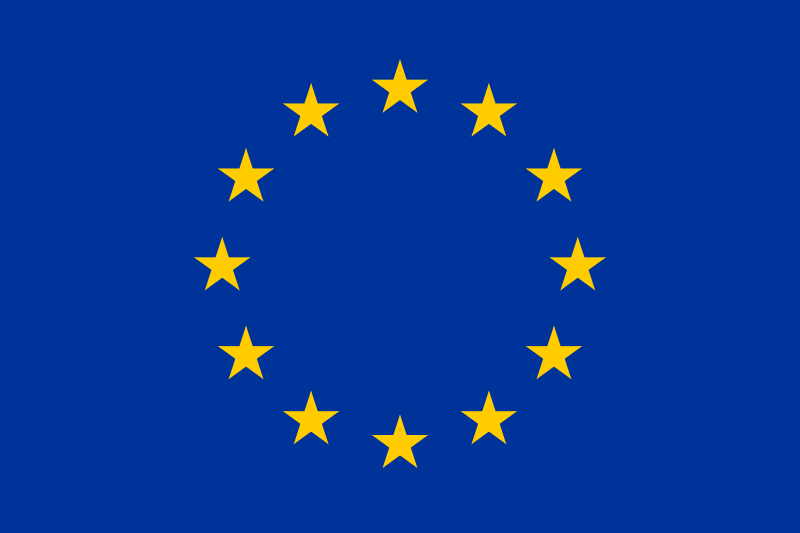
    7. The flag is a circle of 12 golden stars on a blue background. The blue represents the West, while the number and position of the stars represent completeness and unity, respectively. The flag was originally designed in 1955 for the Council of Europe.
    8. Other symbols are a motto - "United in Diversity", an official anthem - an instrumental version of the prelude to the Ode to Joy, the 4th movement of Ludwig van Beethoven's ninth symphony; Europa, a figure from Greek mythology after whom the continent was named, and who was raped by Zeus in the form of a white bull (make of that what you will). Europa appears on the 2013 series of Euro banknotes. The bull is depicted on all residence permit cards. Charles the Great, also known as Charlemange, nicknamed "Father of Europe"is also used a symbol and one of the central EU buildings in Brussels is named for him.
    9. The EU won a Nobel Peace Prize in 2012.
    10. When the Euro currency was introduced in 2002, the initial letters of the countries adopting it spelt out ‘baffling pigs’. Five more countries have now joined, so now it spells out ‘begs piffling scams’.

    **************

    Sick of the referendum? Why not get into a jolly good book until it's all over? Like my new novel, for example:

    New! 

    Running in the Family

    An alien craft approaches Earth. The alien on board is a fugitive, fleeing from an arranged marriage to freedom on our world. She befriends James, a genetics student, and shares her knowledge about the future of the human race with him. 

    A science experiment gone wrong gifts James with superhuman abilities; but they come at a price, leading him to mentor others like himself. He founds a group of amateur heroes called the Freedom League.

    The Freedom League suffers a string of losses and tragedies; it seems doomed to failure; but one of its members, Peter Mayfield, has vowed to form a group of his own. He is determined to keep his vow, despite having lost Rosemary, the one person he wanted by his side to help him.

    Lizzie Hopkins is a talented young athlete and dancer. Peter sees her in action and guesses her exceptional abilities are far more than they seem. He offers to train and mentor Lizzie - but her mother is violently opposed to his suggestion.

    As soon as she is old enough, Lizzie takes matters into her own hands; she seeks out Peter and his group for herself. She soon makes a discovery which shakes her world at its very foundations. Her search for the truth will resolve many unanswered questions, but it will also stir up old heartbreaks dating back to the Freedom League's early days.

    Available from:


    Thursday, 17 March 2016

    17th March: Hell's Angels

    The Hell's Angels Motorcycle Corporation was founded on this date in 1948. Here are some facts about the Hell's Angels you may not be aware of:

    1. It's not a gang, it's a club - the full title is Hell's Angels Motorcycle Corporation (HAMC). It's the world's largest motorcycle club and has charters all over the world, including ArgentinaGreeceIcelandRussia, and Turkey.
    2. It began in 1948 after the Hollister riot in 1947 in which existing motorcycle clubs took part. Otto Friedli, a member of one of these clubs, a club called The Pissed Off Bastards of Bloomington, split to form his own. The name "Hell's Angels" was suggested to him by Arvid Olsen, his associate, who'd served in the Flying Tigers' "Hell's Angels" squadron in China during World War II. According to a Howard Hughes film, this squadron was famous for its dangerous feats of aviation.
    3. The first charter outside the USA was formed in AucklandNew Zealand, in 1961. They arrived in the UK in 1969 when two charters formed in London - the "South London" and "East London", which amalgamated to form one London charter a few years later. The London Angels provided security at a number of UK Underground festivals.
    4. The Hell's Angels have a website. www.hells-angels.com.
    5. Fancy becoming a Hell's Angel member? If you have a valid driver's license, a motorcycle over 750cc, are not a child molester, policeman or prison officer you might be in with a chance. Prospective members first become "hang arounds" who attend the occasional event. They may then be invited to become an "Associate" for a couple of years, then a "prospect" where they can participate more but don't get to vote. During this period they are being evaluated for suitability by their peers, and may visit all the local charters (eg in their state) to make themselves known to the people with the power to vote them in. Finally, they must be unanimously voted in. They then become full members, usually by a formal induction, and are entitled to wear the full set of membership patches. The step of attaining full membership is sometimes referred to as "being patched".
    6. However, if you're not a white male, forget it. Officially, the club is not racist, although according to founding member Sonny Barger, "we probably have enough racist members that no black guy is going to get in it". There is, however, a black motorcycle club called the East Bay Dragons. Its founder, Tobie Levingston, and Barger are said to be good friends and sometimes ride together. There's also a club for women, called the Leather and Lace Motorcycle Club.
    7. The Hells Angels have a system of patches similar to military medals. All members will wear the death's head logo patch, one identifying which charter they belong to and one stating their rank in the organisation (eg. President, Vice President, Secretary, Treasurer, Sergeant at Arms). Others identify specific or significant actions or beliefs of each biker. The meanings of may of them aren't known to people outside the organisation. Some wear one with "1%" on it, which originates from a comment made by American Motorcyclist Association (AMA) that 99% of motorcyclists were law-abiding citizens.
    8. Common nicknames for the club are the "H.A.", "Red & White" (from the colours of the patches), and "81" (from the positions in the alphabet of the letters H and A).
    9. The Hell's Angels tried to sue Disney. In 2007 they filed a suit against the Walt Disney Motion Pictures Group alleging that they'd used the name and logo of the Hells Angels Motorcycle Corporation without permission in a film called Wild Hogs. They settled out of court when Disney assured the Angels the references would not appear in the film.
    10. The club's motto is "Angels Forever, Forever Angels". There's also an unofficial one, "When we do right, nobody remembers. When we do wrong, nobody forgets." For despite their sometimes fearsome reputation and being considered an organised crime syndicate by the U.S. Department of Justice, the Hell's Angels often raise money for charities, such as The Red Cross Toys for Tots, the Salvation Army, the Muscular Dystrophy Association, and various veteran’s and children’s charities - but people often aren't aware of that.

    Tuesday, 29 December 2015

    29th December: YMCA

    Today is the anniversary of the first YMCA in the US opening in Boston, in 1851. Here are 10 facts about the YMCA.

    1. YMCA stands for Young Men's Christian Association.
    2. It was founded in London in 1844 by George Williams, a London draper in response to the migration of young men from the country to cities to find work after the industrial revolution. He wanted to provide healthy activities for young men as an alternative to taverns and brothels.
    3. Activities provided have included Bible studies and academic courses, but the YMCA is especially known for promoting physical exercise. At least two sports owe their existence to the YMCA's emphasis on keeping physically fit - Basketball (invented by James Naismith as a game which was interesting, easy to learn, and easy to play indoors in winter) and futsal (a synthesis of three sports, handball, basketball, and water polo, invented by Juan Carlos Ceriani in 1930).
    4. They were also places to stay. In the 1940s in the US, there were more rooms in the YMCAs than there were hotel rooms.
    5. During World War II the YMCA was involved in war work with displaced persons and refugees. They set up War Prisoners Aid to support prisoners of war by providing sports equipment, musical instruments, art materials, radios, gramophones, eating utensils, and other items.
    6. In 1880, the YMCA became the first national organisation to adopt a strict policy of equal gender representation in committees and national boards, starting with Norway.
    7. The first black president of the World Alliance of YMCAs, Charles Dunbar Sherman from Liberia, was also the youngest, at 37.
    8. Logos for the various branches always include a red triangle, representing the Christian principle of developing a healthy "body, mind, and spirit."
    9. Until the 1950s, wearing clothing of any type in YMCA pools was strictly forbidden. The reason given was that fibres from swimwear could clog up the filtration systems. I suspect the YMCA's connection with gay culture wasn't entirely unrelated to this!
    10. The song YMCA by the Village People is one of fewer than forty singles to have sold 10 million physical copies worldwide and is number 7 on VH1's list of the 100 Greatest Dance Songs of the 20th Century. It is said to have been inspired when lead singer Victor Willis was asked by the group's founder, Jacques Morali, "What exactly is the YMCA?" Naturally, the actual YMCA wasn't all that impressed with the song with all its gay culture references - they threatened to sue the band over trademark infringement and concerns about the song's double entendres - but eventually dropped the lawsuit.


    Saturday, 14 February 2015

    19th February: The Women's Institute

    On this date in 1897 The Women’s Institute was founded in Ontario, Canada by Mrs Adelaide Hoodless. A Mrs Watt introduced the WI to Britain during the First World War.

    1. Despite its reputation as an organisation in Britain, the WI was founded in Canada. The very first members were the wives of members of the Farmer's Institute, hence the name, "Women's Institute."
    2. The idea spread to the UK in 1915. The location of the first meeting was a borrowed building in the village of Llanfairpwllgwyngyllgogerychwyrndrobwllllantysiliogogogoch in Anglesey, Wales. Also famous for having the longest place name in the UK.
    3. Membership is only open to women, although there were two males who were members of the first group in Anglesey - Colonel Richard Stapleton-Cotton and his dog Tinker. The Colonel was the husband of the first President and played an important role in the setting up of the first branch. He was, according to local historian Gerwyn James, somewhat eccentric, but passionate about anything that would help rejuvenate the rural economy. He paid membership fees for both himself and Tinker.
    4. Although men cannot become members, they can serve on the committee - in 2010, Peter Bryant was appointed the new secretary of the Gloucestershire Branch of the WI after officials checked that there was no rule against a man having the job. He was not allowed to actually join. From 2007 to 2011, the editor of the WI's magazine, WI LIfe, was also a man, Neal Maidment.
    5. In the beginning, the movement's purpose was to encourage women to become more involved in food production during the first world war, and it was funded by the Board of Agriculture.
    6. Eventually, though, the movement became self-supporting, and in spite of its early history, today it is completely independent from any political party, religion or institution.
    7. The movement's association with the hymn Jerusalem began in 1924. The activities of many branches included choirs by then, and the institute organised a training day for the conductors. Sir Walford Davies was asked to write an arrangement of the hymn especially for the choirs, and after the training day, W.H. Leslie, their music advisor, suggested that the choirs perform the new arrangement at the WI AGM. It was so well-received that it became a permanent feature, and local branches began singing it at the start of their meetings as well. However, Jerusalem has never officially been adopted as the movement's anthem.
    8. If you're interested in the history of the WI, their archives are open to the public. They can be found at the Women's Library at the Library of the London School of Economics ref 5FWI.
    9. Think the WI is for somewhat straight-laced, middle-aged women? Not necessarily. The youngest president of a WI branch was Georgiana Mannion, who founded a branch in Leeds when she was just 24.
    10. There is an "alternative" branch in Merseyside called the Iron Maidens WI, founded in 2012 as an option for women interested in rock music, burlesque, goth culture, steampunk, retro, etc. It is not at all unusual for members of this group to have tattoos, piercings and unusual coloured hair.