Showing posts with label Bridges. Show all posts

Friday, 23 May 2025

24 May: Brooklyn Bridge

On this date in 1883, after over 15 years of construction, the Brooklyn Bridge, connecting the cities of New York and Brooklyn, opened. 10 facts about the bridge:

  1. It wasn’t called the Brooklyn Bridge when it opened. During construction, it had been referred to as the “Great East River Bridge” or the “Great East River Suspension Bridge." When it was opened it was dubbed the “New York and Brooklyn Bridge.” It wasn’t called the Brooklyn Bridge until 1915.

  2. Construction of the first fixed crossing of the East River began on 2 January  1870. It was also the first bridge to use steel for cable wire. For a time, it was the longest bridge in the world with a span of just over 1,595 feet/486 metres. Its reign ended in 1890 when the Firth of Forth cantilever bridge in Scotland was built. It remained the longest suspension bridge in the world until 1903 when Williamsburg Bridge was built nearby.

  3. Around 20-30 people lost their lives during construction (there were no official figures kept at the time). The first fatality was John A. Roebling, the designer of the bridge, who was taking readings for a survey before construction even started. His foot got crushed between pilings and a boat; he died of tetanus a few days later.

  4. His son, Washington Roebling, took over the overseeing of the construction, but he suffered an accident too, and ended up bedridden. His wife, Emily Warren Roebling, stepped in to help. At first, her job was mainly to relay messages from her husband to the site, but she ended up doing much more and ended up taking charge of overseeing the design, construction, and business management. Once the bridge was finished, Emily was regarded as a pioneering female engineer. She went on to take a degree in law.

  5. A number of the deaths and injuries, including that of Washington Roebling, were caused by decompression sickness, or the bends. This was because they had to work in underground structures called caissons, sealed chambers that kept the riverbed dry and allowed for digging. The air inside was compressed and coming back up could cause decompression sickness. Doctors at the time didn’t know what it was, and called the condition “caisson disease”.

  6. Emily Warren Roebling was the first person to cross the bridge when it opened. She rode over in a carriage with a rooster on her lap, the bird being a symbol of good luck and victory. After that, President Chester Arthur, New York Governor (and future president) Grover Cleveland and various local politicians marched onto the bridge, along with a military band and troops. When they reached the opposite side a cannon was fired and there was a Firework display that lasted for an hour. There were speeches and receptions before the bridge opened to the public. More than 150,000 people went across in the first day.

  7. However, the bridge’s troubles weren’t quite over. About a week later there was a stampede in which 12 people were crushed on a crowded stairwell. It started because of a rumour that the bridge was about to collapse. No changes came about in the immediate aftermath of the tragedy, except that more police were stationed on the pedestrian promenade. Fears that the bridge could collapse didn’t go away, and to show that it was perfectly safe, P.T. Barnum took 21 Elephants over the bridge in May 1884.

  8. When the bridge first opened, people had to pay a toll to cross. It cost one cent to cross by foot, 5 cents for a Horse and rider and 10 cents for a horse and wagon. Farm animals cost 5 cents per Cow and 2 cents per Sheep or Pig. The pedestrian toll was repealed in 1891, and the vehicle toll in 1911 with the support of New York Mayor William J. Gaynor, who said, “I see no more reason for toll gates on the bridges than for toll gates on Fifth Avenue or Broadway.”

  9. The engineers built vaults up to 50 feet tall into the bridge under its anchorages. These were rented out to the public as wine cellars until World War I. During the cold war, one of them was turned into a fallout shelter which was rediscovered in 2006 during a routine structural inspection of the bridge.

  10. The bridge appears in works by Georgia O'Keeffe and Andy Warhol, and has been a filming location many times. It Happened in Brooklyn, Moonstruck, Godzilla and Spider-Man are among the films it has appeared in. It has also become home to a pair of peregrine falcons.


Beta

(Combat Team Series #2)


Steff was abducted by an evil alien race, the Orbs, at fourteen. Used as a weapon for years, he eventually escapes, but his problems are just beginning. How does a man support himself when his only work experience is a paper round and using an Orb bio-integrated gun?

Warlord is an alien soldier who knows little but war. When the centuries-old conflict which ravaged his planet ends, he seeks out another world where his skills are still relevant. There are always wars on Earth, it seems. However, none of Earth's powerful armies want him.

Natalie has always wanted to visit England and sees a chance to do so while using her martial arts skills, but there are sacrifices she must make in order to fulfil her dream. 

Maggie resorted to crime to fund her sister's medical care. She uses her genetic variant abilities to gain access to the rooms of wealthy hotel guests. The Ballards look like rich pickings, but they are not what they seem. When Maggie targets them, little does she know that she is walking into a trap.

Hotel owner Hamilton Lonsdale puts together a combat team to pit against those of other multi-millionaires. He recruits Warlord, Natalie, Maggie and Steff along with a trained gorilla, a probability-altering alien, a stockbroker whose work of art proved to be much more than he'd bargained for, a marketing officer who can create psionic forcefields, a teleporting member of the landed gentry, and a socially awkward fixer. This is Combat Team Beta.

Steff never talks about his time with the Orbs, until he finds a woman who lived through it, too. Steff believes he has finally found happiness, but it is destined to be short-lived. He is left with an unusual legacy which he and Team Beta struggle to comprehend; including why something out there seems determined to destroy it.


Paperback

Thursday, 25 May 2023

26 May: Vauxhall Bridge

On this date in 1906 Vauxhall Bridge opened. 10 things you might not know about it:

  1. Vauxhall Bridge is a Grade II listed steel and granite deck arch bridge which crosses the River Thames in a southeast–northwest direction between Vauxhall on the south bank and Pimlico on the north bank. It is 247 metres long and 24 metres wide.

  2. There may well have been a crossing on this site 3,500 years ago. In 1998, the Thames Archaeological Survey found the remains of an oak crossing dating to around 1500 BC.

  3. The bridge that is there today replaced an earlier bridge, known as Regent Bridge but later renamed Vauxhall Bridge, built between 1809 and 1816 as part of a scheme for redeveloping the south bank of the Thames.

  4. The current Vauxhall Bridge was the first in London to carry trams.

  5. It was one of the first two roads in London to have a Bus lane.

  6. The road it carries is the A202.

  7. The bridge was designed by Sir Alexander Binnie and Sir Maurice Fitzmaurice.

  8. The design was quite functional, and so the LCC began debating ways to make the bridge more interesting. They consulted with architect William Edward Riley regarding possible decorative elements that could be added to the bridge. He suggested two 60-foot (18 m) pylons topped with statues at one end of the bridge, and adding sculptures to the bridge piers. The pylons were rejected on grounds of cost, but the statues were commissioned and are there to this day. They are not visible from the bridge itself. The statues represent Agriculture, Architecture (this one is holding a model of St Paul's Cathedral), Education, Fine Arts and Engineering. They are made from bronze, weigh two tons each and were designed by Alfred Drury and Frederick Pomeroy.

  9. In 1963 another grand scheme was proposed but abandoned because of the cost. This was to replace the bridge with a glass structure called the Crystal Span, inspired by the design of the Crystal Palace. An air conditioned glass shell would contain the road, shops, a luxury hotel, a gallery space to be used by the Tate Gallery, a skating rink and roof gardens including an open air theatre.

  10. For a while there was another bridge just 200yards (180 m) downstream. During the Second World War the government was concerned that Axis bombers would target Vauxhall Bridge, so a temporary bridge known as Millbank Bridge was built parallel to it. Millbank Bridge was made of steel girders supported by wooden stakes. Despite its flimsy appearance it was capable of supporting tanks and other heavy military equipment. In the event, Vauxhall Bridge survived the war undamaged, and in 1948 Millbank Bridge was dismantled.


Character birthday

Blatt, aka Ian Poole, a former bouncer at a sleazy club. The club was a favourite haunt of Leopold Smythe-Warner, leader of the Demolition Squad. Poole viewed Smythe-Warner as a man who commanded respect and appeared to him to have a finger in any number of lucrative pies. Smythe-Warner was impressed by Poole's "professional technique", in particular one occasion when he broke a man's legs with a single blow. On witnessing that, Smythe-Warner invited Poole to join the Demolition Squad and take the code name Blatt.

Blatt has no powers, although he is strong and an expert brawler. He holds a deep seated mistrust of people with powers, for reasons unknown, including Smythe-Warner himself, although the fact that he uses a crossbow rather than relying entirely on powers redeems him in Blatt's eyes.

Blatt sees himself as the leader of the non-powered section of the Squad, rather like a drill sergeant with a particularly useless bunch of recruits. He feels it is his duty to lick them into shape.


Wednesday, 19 May 2021

20 May: Kew Bridge

The present Kew Bridge opened on this date in 1903. 10 things you might not know about it:

  1. Kew Bridge is 1,182 feet (360 m) long and 75 feet (23 m) wide.
  2. It carries the A205 road, and forms a link between the North Circular and the South Circular, which means the bridge can get quite congested at times.
  3. It is located in in the London Boroughs of Richmond upon Thames and Hounslow. It is next to the Royal Botanic Gardens (Kew Gardens) on the south side of the river and the former Grand Junction Waterworks Company buildings, now the London Museum of Water and Steam, on the north.
  4. There have been three bridges on the site. Before the first one, there was a ferry owned by Robert Tunstall of Brentford. He must have got tired of running the ferry, because he was also the one who had the first bridge built.
  5. The first bridge was opened in June 1759 by George, the then Prince of Wales, who drove over it with his mother and various members of the royal family. It was opened to the public three days later and 3,000 people crossed in one day. It was a toll bridge: pedestrians had to pay one penny; a coach and four Horses a shilling and sixpence. In today's money that would be 64p and £17.
  6. 30 years later, the bridge needed replacing. In 1782, Robert Tunstall, the son of the first Robert Tunstall, sought permission to build a new bridge. The second bridge was built alongside the first, so that traffic could keep flowing during construction work. This bridge was built entirely of stone.
  7. The second bridge was opened in September 1789, again by George, who by now was King George III. He crossed it with a great concourse of carriages.
  8. This bridge lasted until the 1890s when it became clear it could no longer cope with the traffic and the Brentford approach was too narrow and steep. The engineer Sir John Wolfe Barry assessed the bridge in 1892 and recommended building a new bridge rather than making modifications to the existing one. This time, a temporary wooden bridge was built alongside to keep the traffic moving while the new bridge was built.
  9. The current bridge was commissioned jointly by the Middlesex and Surrey county councils at a cost of £250,000 (£28.1 million in today's money). The engineers were Barry and Brereton and the building contractors were Easton Gibbs and Son. The bridge is built from Cornwall granite.
  10. It was opened on 20 May 1903 by King Edward VII and Queen Alexandra and was originally called King Edward VII Bridge. However, this name never really caught on and the name reverted back to Kew Bridge.

My Books:


If you like stories about:

  • Superheroes
  • Psychic detectives
  • Romance
  • Alternative dimensions
  • Time travel 
  • Secrets
  • Friendship
  • Family relationships
  • Ghosts
  • Adventure
  • Crime

If you want to read about superheroes who aren't the usual Marvel/DC staples, who don't all live in the USA.

If you like quirky tales.

If you like to support independent self published authors.

Check out my books page.


Monday, 29 March 2021

30 March: Bridges

On this date in 1909, the first double-deck bridge, The Queensboro Bridge in New York, opened to traffic, linking Manhattan and Queens. 10 things you might not know about bridges:

  1. The earliest type of bridge was probably stepping stones. Neolithic people used to build walkways across marshes. An example is the Sweet Track in Somerset which is approximately 6000 years old. It's so called because it was discovered by an archaeologist named Sweet. The oldest bridge in continuous use, according to the Guinness Book of Records, is the Caravan Bridge, a stone arch span over the Meles River in Izmir, Turkey, which is 3,000 years old.
  2. The world's highest bridge is the Beipanjiang Bridge, in south west China. It rises 1,854 feet above a river. The longest is the Lake Pontchartrain Causeway in Louisiana, which is 24 miles long. For 8 of those miles, you can't even see the land at either end.
  3. The longest combined road and railway bridge in Europe is situated at the border between Sweden and Denmark. It has the additional feature of turning into a tunnel for part of the crossing. This was so it wouldn't inconvenience air traffic coming and going from nearby Copenhagen airport.
  4. There is a word for the fear of crossing bridges: gephyrophobia. It seems there are a lot of people in MichiganUSA, who suffer from that. The Mackinac Bridge there is five miles long and over 200 feet high. The bridge has a Drivers Assistance Program in which people who are too scared to drive over themselves can be driven over by a member of staff. About 1,200 to 1,400 use this service.
  5. Then again, they might be more justified than you'd think, since the 607,380 bridges in the USA are on average over 40 years old and 11% of them are considered structurally deficient.
  6. While we think of bridges as man made objects, Nature is more than capable of building bridges, too. The largest natural bridge in the world is in China and is called the Fairy Bridge. Until 2010 it was virtually unknown outside China. The Natural Arch and Bridge Society only learned of it when one of their members found it on Google Earth in 2009. They sent a party to measure it in 2010 and they found it was the largest natural bridge in the world by a wide margin. It's also possible to make bridges from living tree roots, which automatically strengthen over time, although it does take about 15 years to build such a bridge.
  7. In 480 BC, King Xerxes I of Persia built bridges to invade Greece. However, all the bridges he built got destroyed by storms. Eventually, in a true Basil Fawlty moment, he whipped the sea, threw chains at it, burned the water with red hot irons and got his men to yell at the water. The next bridge he built remained standing.
  8. The Euro currency was designed to feature fictitious bridges, meant to represent architectural styles across Europe while not favouring any one country. Which worked fine until the Netherlands decided to build them for real.
  9. Brooklyn Bridge in New York has Wine cellars underneath it. They were a money-making scheme to help pay for the bridge as they charged wine merchants for storage of their wine as the vaults were always cool. The cellars are still there but no longer in use.
  10. Bridges are often where people go when they want to commit suicide, so some of the highest bridges have prevention measures such as plaques with helpline numbers or even people who try to talk would be suicides out of it. The most bizarre suicide bridge, however, is the Overtoun Bridge in Dumbarton, Scotland, where over the past fifty years, about one dog a year has suddenly, without warning and for no apparent reason, thrown itself off the bridge to its death, 50 feet below. The doggy suicides always take place in the same section of the bridge and all of them have been breeds with long noses. It has led people to wonder if the bridge is haunted. Overtoun is Celtic for "the thin place," an area where this world and the next are said to be close; so who knows? Its curse once extended to the human race when in 1994, a man threw his baby son off the bridge because he thought the baby was the Anti-Christ.

My Books:


If you like stories about:

  • Superheroes
  • Psychic detectives
  • Romance
  • Alternative dimensions
  • Time travel 
  • Secrets
  • Friendship
  • Family relationships
  • Ghosts
  • Adventure
  • Crime

If you want to read about superheroes who aren't the usual Marvel/DC staples, who don't all live in the USA.

If you like quirky tales.

If you like to support independent self published authors.

Check out my books page.

Thursday, 2 July 2020

3 July: Chiswick Bridge

Chiswick Bridge opened on this date in 1933. 10 things you might not know about Chiswick Bridge:


  1. The bridge is made from reinforced concrete and is faced with 3,400 tons of Portland stone.
  2. It is 606 feet (185 m) long and 70 feet (21 m) wide.
  3. It has five spans, but only three of them are over the river. The two at either end of the bridge are shorter and cover the former towpaths. When the bridge was first built, the centre span was the longest concrete span over the Thames at 150-foot (46 m).
  4. The designers were architect Sir Herbert Baker and engineer Alfred Dryland, who took advice from Considère Constructions, at the time Britain's leading specialist in reinforced concrete construction.
  5. In the 17th century, there was a ferry where the bridge is now, which linked the small villages of Chiswick and Mortlake. Because they were small villages, it was never deemed worth building a bridge there.
  6. Things changed however, with the arrival of railways, the London Underground and car ownership, making commuting into London from Chiswick and Mortlake more practical and affordable. The population in the area grew rapidly and by 1928, a new road, the A316, was given Royal Assent. The road would cross the river in two places, Chiswick and Twickenham, so bridges were needed in those two places.
  7. The bridge was built by the Cleveland Bridge and Engineering Company at a cost of £208,284 (about £14,524,000 in today's money).
  8. Chiswick Bridge was opened by Edward, Prince of Wales on 3 July 1933, and at the same time, the ferry service closed forever.
  9. The name of the bridge, Chiswick, comes from the Old English for "Cheese farm".
  10. The bridge's biggest claim to fame is that it is 370 feet (110 m) away from the end of the Oxford and Cambridge Boat Race. The end of the course is marked by a University Boat Race Stone on the south bank, and a brightly painted Blue and Black marker post near the north bank.

MY LATEST BOOK!

Killing Me Softly

Sebastian Garrett is an assassin. It wasn’t his first choice of vocation, but nonetheless, he’s good at it, and can be relied upon to get the job done. He’s on top of his game.

Until he is contracted to kill Princess Helena of Galorvia. She is not just any princess. Sebastian doesn’t bargain on his intended victim being a super-heroine who gives as good as she gets. Only his own genetic variant power saves him from becoming the victim, instead of Helena. 

Fate has another surprise in store. Sebastian was not expecting to fall in love with her.

Available on Amazon:

Paperback

Sunday, 14 July 2019

19 July: Lambeth Bridge

On this date in 1932 Lambeth Bridge opened. 10 things you might not know about Lambeth Bridge.

  1. Thanks to the Archbishops of Canterbury, whose London residence is at Lambeth Palace, there has been some kind of river crossing at the site of Lambeth Bridge since at least 1367, when it's recorded that the clerks of chancery were paid £16 for a barge to ferry the then Archbishop, Simon, across the river.
  2. By 1513 there was a ferry here for Horses and horsedrawn carriages. The horseferry between the Palace of Westminster and Lambeth Palace was the only way to get across the Thames in central London for quite some time. The Archbishop of Canterbury owned the lease to the ferry which came to an end in 1750 when Westminster Bridge opened. Lambeth Palace had a landing stage where the Archbishop received important visitors. Today, all that's left of the horse ferry is the road that once led to it - Horseferry Road.
  3. As early as 1664 people wanted a bridge at Lambeth, but the ferry owners blocked it. Finally in 1737, an act of Parliament was passed to put a bridge there but it wasn't built until 1861. That bridge was a suspension bridge 828 feet (252.4 m) long, designed by Peter W. Barlow, which cost £48,924 to build. It wasn't a great success. It has a steep incline which made crossing in a horse and carriage difficult, so it was used mostly as a footbridge. It was closed to vehicles in 1910 because The girders and cables were already starting to deteriorate.
  4. The bridge that is there now was opened in 1932 by King George V and Queen Mary. It was designed by engineer Sir George Humphreys and architects Sir Reginald Blomfield and G. Topham Forrest. It is a five span steel arch.
  5. It is 236.5m long and 18m wide. It carries the Lambeth Road and has three lanes, one of which is for Buses only.
  6. It is painted Red for a reason - the red colour scheme matches the seats in the House of Lords. The Houses of Parliament are located on the north bank between Lambeth and Westminster Bridges. The House of Lords is nearest to Lambeth Bridge. Westminster Bridge, nearer to the House of Commons, is painted Green to match the seats in there.
  7. The crests on the sides of Lambeth Bridge represent the London County Council, which was responsible for building it.
  8. The objects on top of the obelisks at either end are said by some to be Pineapples, placed there as a tribute to John Tradescant the younger, head gardener to Charles I, famous for growing the first pineapples in Britain. He is buried nearby, in the churchyard of St-Mary-at-Lambeth. However, this is merely an urban myth. The objects are actually pine cones. What they represent isn't quite so obvious. They could have been included by Masons as a symbol of enlightenment, or they could represent ancient symbols of hospitality or eternal life.
  9. Lambeth Bridge was the first Thames Bridge to be tunnelled beneath to provide pedestrian access along the embankment, in 1965.
  10. Lambeth Bridge has appeared in several films. It was used as a locaton for Woody Allen's Match Point; The Greater Good; the James Bond film Spectre (in which a boat and helicopter pass over and under it); Fast And Furious 6 (in which the bridge and the buildings around it stand in for Moscow); the Jackie Chan film The Foreigner (in which a bus explodes on the bridge, freaking out a few passers by who weren't in the know during filming) and Harry Potter and the Prisoner of Askaban (in which the Knight Bus races over the bridge squeezing between two regular London buses.

Tuesday, 11 June 2019

11 June: Hammersmith Bridge

On this date in 1887 Hammersmith Bridge opened. Here are 10 things you might not know about Hammersmith Bridge.


Hammersmith Bridge
  1. The bridge which stands on the site today is the second bridge to be built there. The first one was designed by William Tierney Clark and opened in 1827. It was the first suspension bridge over the River Thames.
  2. By the 1850s, however, there were concerns that this bridge wasn't strong enough. In the 1860s, when crowds gathered on the bridge to watch the boat race (as Hammersmith Bridge was the half way point), as about 11,000 people moved from side to side to watch the race, the bridge actually swayed from side to side.
  3. The current bridge was designed by Sir Joseph Bazalgette and was opened by the Prince of Wales on 11 June 1887.
  4. When it was first built, it was painted Pink - that was the undercoat - it was a year before Bazalgette's chosen colour of Green was painted over the top.
  5. This one isn't strong enough, either. There's more traffic now than there was in 1887 so there's still a problem. Traffic had to be severely restricted with only one Bus in either direction allowed on it at a time. In April 2019 it was closed to motor traffic completely although people can still walk or cycle across.
  6. Hammersmith Bridge is 700 feet (210 m) long and 43 feet (13 m) wide.
  7. It is also the lowest bridge over the river Thames, with just 12 feet (3.6m) water clearance at high tide.
  8. There is a motif on the bridge made up of seven coats of arms. In the middle is the present Royal Arms of the United Kingdom and surrounding it are (clockwise from the left): the coat of arms of the City of London; Kent; Guildford; the original coat of arms of the City of Westminster (with the portcullis); the coat of arms of Colchester; and Middlesex (in its original form without the crown). They are not, however, painted in their original colours but in gold and green.
  9. There is a plaque on the bridge commemotating the bravery of one Lieutenant Charles Campbell Wood from Bloemfontein in South Africa, who dived from the bridge in December 1919 to save a drowning woman. The woman survived but Campbell Wood died of tetanus contracted from his injuries two weeks later.
  10. His was not the last act of bravery the bridge has seen. In 1939, a Chiswick hairdresser called Maurice Childs was walking home across Hammersmith Bridge when he spotted a smoking suitcase on the pavement. Childs threw the case, which contained an IRA bomb, into the river where it exploded, producing a 60-foot (18m) column of water. Childs was later awarded an MBE.


The Raiders Trilogy


Book One
Book Three
Book Two
   

Power Blaster is a superhero who lives in a dimension not unlike our own, in the mega-nation of Innovia. No-one knows who he is or where his powers come from. 
After saving the life of the President several times, Power Blaster learns that a test of a nuclear warhead to defend the planet against asteroid strikes will have devastating consequences for his world and sets out to prevent it.

Power Blaster's actions lead to an unexpected result - a wormhole opens between his dimension and our own. Anyone in the vicinity is pulled through. People from diverse backgrounds and cultures must co-operate to survive and learn to live with the powers travel through the wormhole has bestowed on some of them.

A stable wormhole is established between the two dimensions. Power Blaster is determined to bring Desi Troyes, the person responsible for the bomb, to justice. Help comes from some rather unexpected sources. Meanwhile, Shanna Douglas sets out on a mission of her own, to find out if there is a cure for the life altering condition the wormhole gave her friend, Benedict Cole. Little does she know that she will stumble upon the secret of Power Blaster's mysterious origins.

Sunday, 10 June 2018

10 June: The Millennium Bridge

On this date in 2000 the Millennium Bridge, the footbridge across the River Thames opened.


  1. Officially known as the London Millennium Footbridge, it is a steel suspension bridge for pedestrians crossing the River Thames in London. It is located between Southwark Bridge and Blackfriars Railway Bridge.
  2. Its total length is 325 metres (1,066 ft) and its width is 4 metres (13 ft).
  3. The Millennium Bridge was London’s first new Thames crossing in more than 100 years. There hadn't been any new bridges since Tower Bridge opened in 1894. This might be because bridges across the Thames usually require an Act of Parliament. For this bridge, the Port of London Authority granted a licence for the structure by obtaining planning permission from the City of London and London Borough of Southwark.
  4. The design of the bridge was the subject of a competition organised in 1996 by Southwark council and RIBA Competitions. The winning entry was the "blade of light" effort from Arup Group, Foster and Partners, and Sir Anthony Caro. Due to height restrictions, and to improve the view, the bridge's suspension design had the supporting cables below deck level.
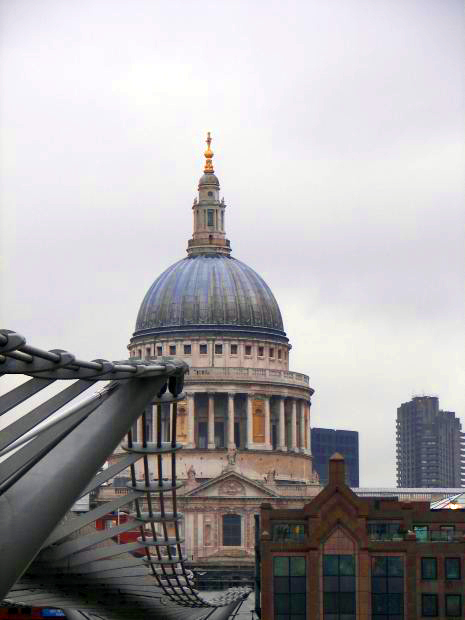
  5. The view is pretty iconic. Pedestrians crossing the bridge get a great view of St Paul's Cathedral, Tower Bridge and The Shard.
  6. On the day of opening, the bridge was crossed by 90,000 people, with up to 2,000 on the bridge at any one time.
  7. It soon became apparent the designers hadn't realised the extent of the effect so many people walking over it would have. The tendency of a suspension bridge to sway when troops march over it in step was well known, and troops are required to break step when crossing such a bridge. Albert Bridge in London has a sign dating from 1873 warning marching ranks of soldiers to break step while crossing. What wasn't so well researched was the tendency of pedestrians not marching in time, to unconsciously fall into step in response to slight sways in the bridge - they all lose balance slightly and step to the side to regain it, all at the same time. 2,000 people doing this makes the sway worse, so they all have to regain their balance some more and this is what made the bridge wobble. Two days after it opened, it had to close for modifications.
  8. The problem was solved by fitting 91 dampers to absorb lateral and vertical oscillations. The modifications took nearly as long as building the bridge in the first place. Construction began in 1998 and it opened in June 2000. It closed on 12th June 2000 and was reopened on 27th February 2002. The changes cost an extra £5m over the £18.2M building cost which was already £2.2M over budget.
  9. On 18 January 2007, the bridge was temporarily closed due to strong winds and a risk of pedestrians being blown off the bridge.
  10. The Millennium Bridge appeared in the sixth Harry Potter film. The bridge collapsed following an attack by Death Eaters.


More details about my books. Follow this link if you like Superheroes, Psychics and/or quirky short stories. 
I've listed the themes each novel touches on here for easy reference.

Like my author page on Facebook for news on new books and blog posts.

Follow me on Twitter and Pinterest
Check out my Writing blog

Monday, 21 May 2018

29 May: Putney Bridge

The current Putney Bridge opened on this date in 1886. Here are ten things you might not know:


  1. Like many London bridges, the Putney Bridge we know today is a replacement for an earlier bridge. The first Putney Bridge was officially known as Fulham Bridge, and was opened on 29 November 1729. It was made of wood, built by Thomas Phillips to a design by architect Sir Jacob Acworth.
  2. Before this, there was only one bridge across the Thames in London - London Bridge. People in Putney and Fulham who wanted to cross the river had to take a ferry. The ferry wasn't all that reliable and it wasn't unknown for the ferryman to leave his post and go drinking in a nearby pub. It was only when someone influential, Prime Minister Robert Walpole, to be exact, was inconvenienced by a ferryman being in the pub rather than with his boat, when making his way from a visit to King George I back to Parliament, that public demands for a bridge were listened to.
  3. The first bridge was a toll bridge. In its early years it would bring in £1,500 per year — about £130,000 in today's money. The Prince of Wales would pay £100 a year for he and his family to cross the bridge as often as they liked. The toll was removed in 1877 when all London's bridges were taken into public ownership.
  4. Feminist Mary Wollstonecraft threw herself off Putney Bridge in 1795 when she found out her partner was having an affair with an actress. She was rescued by passing boatmen, who resuscitated her. If they hadn't, she would never have married William Godwin or given birth to Mary Shelley, who wrote Frankenstein.
  5. The current bridge, which dates from 1886 was designed by civil engineer Sir Joseph Bazalgette and is made from stone and Cornish granite. Bazalgette also designed London's sewerage system, and the bridge incorporates part of the overflow to his system. The cages under the bridge are to prevent people from getting into the sewers (though why anyone would want to is a mystery). There is a myth that the cages were used to drown criminals. This is untrue.
  6. Another myth concerns the names of the areas on either bank. This story goes that there were two sisters who lived on opposite sides of the bank, who would frequently visit each other, by means of the ferry. The names come from the directions the women would give to the ferryman - one used to say, 'Full home, waterman,' while the other would say, 'Put nigh'.
  7. Putney Bridge is the only bridge in Britain to have a church at each end. On the north bank is All Saints' church; on the south bank is St Mary's church, the site of the famous Putney Debates on the English constitution.
  8. The current bridge was constructed by John Waddell of Edinburgh at a cost of £240,433 (£22,223,526 in today's money).
  9. It is 700 feet (210m) long, 43 feet (13m) wide and carries the A219 road.
  10. Putney Bridge is often said to be the starting point for the Oxford and Cambridge Boat Race. The race actually starts slightly upstream of the bridge, but people can get a very good view of the start from the bridge.


More details about my books. Follow this link if you like Superheroes, Psychics and/or quirky short stories. 
I've listed the themes each novel touches on here for easy reference.

Like my author page on Facebook for news on new books and blog posts.

Follow me on Twitter and Pinterest
Check out my Writing blog

Friday, 30 June 2017

30th June: Tower Bridge

Tower Bridge was opened on this day in 1894 by the then Prince of Wales, the future King Edward VII.

  1. Before the bridge was built, anyone wanting to cross the river there would have had to use the Tower Subway - a 410-metre tunnel under the river, and pay half a penny for the privilege. The tunnel is still there, but now it's a water main.
  2. It was eventually decided that a bridge was needed but planners faced a problem - it was still important for tall ships to be able to sail up the Thames. A competition was held to design the bridge. Over 50 designers entered, including civil engineer Sir Joseph Bazalgette, whose major achievement was the creation of a sewer network for central London. Some of the designs were quite wacky. Bazalgette's design was rejected because of a lack of sufficient headroom. It took the judging committee eight years to pick a winner, and in the end, they chose a design by Sir Horace Jones, the City Architect, who was actually on the committee.
  3. It took as long to decide on the designer as it did to build the actual bridge, which also took eight years. It cost £1,184,000 to build, over £100 million in today's money. It took over 400 workers, over 70000 tons of concrete and 11,000 tons of steel to construct the bridge, which is is 244 metres long; each tower is 65 metres high. The pedestrian walkways are over 40 metres above the river at high tide. The central span is 200 feet (61m).
  4. It is the only bridge on the Thames which can be raised. The central span which carries the A100 road is split into two bascules which can be raised to an angle of 86 degrees to allow a ship to pass through. Each bascule weighs over a thousand tons and is moved by means of a hydraulic engine. It takes 61 seconds to raise the bascules. At one time this would happen about 50 times a day but nowadays it's down to four or five times a week.
  5. Ship owners who want to pass through don't have to pay a charge but they do have to give 24 hours notice. River traffic always has priority over road traffic, so if you arrive at the bridge in your car at the same time as a ship, you'll face a Red traffic light and probably a queue. No exceptions - even if you are President of the United States of America, you'll still have to wait, as Bill Clinton found out in 1997 when his motorcade was split because a barge named Gladys was scheduled to pass through. The authorities at Tower Bridge had tried to warn the President that this might happen, but the American Embassy didn't answer the phone.
  6. The most exciting London Bus ride ever must have been if you'd happened to catch a number 78 bus one December day in 1952. In those days the procedure for opening the bridge wasn't Traffic Lights, but a warning bell and gates which had to be closed by a gateman who would then signal to the watchman that the bridge was clear. A relief watchman missed the signal and started opening the bridge while the double decker bus was still on it. The quick thinking driver, one Albert Gunton, put his foot down and the bus jumped the 3ft (0.91m) gap and dropped 6 feet (1.8m) onto the north bascule, which hadn't started to rise. Gunter was given £10 (equivalent to £260 in 2015) by the City Corporation to honour his act of bravery. No-one was hurt but it must have been a scary ride!
  7. Tower Bridge is not called Tower Bridge because it has towers - it was actually named for the nearby Tower of London. People who don't know London frequently think Tower Bridge is called London Bridge, possibly because Tower Bridge is one of London's iconic buildings used on films to indicate that the action is taking place in London. London Bridge is a completely different bridge further along the river. There's a common urban myth that says an American millionaire bought the old London Bridge when it was being rebuilt, under the misconception that he was getting Tower Bridge.
  8. It may be iconic and a favourite of people today, but it had its haters when it was first built, among them H.H. Statham, who called it "the vice of tawdriness and pretentiousness" and Frank Brangwyn who said that "A more absurd structure than the Tower Bridge was never thrown across a strategic river".
  9. High above the road is a walkway which is sufficiently high that it never needs to be raised. It started off as a pedestrian walkway but pedestrians rarely used it because you had to climb a lot of steps to get to it, and it became a haunt for prostitutes and pickpockets. It closed in 1910 but re-opened in 1982 as part of the Tower Bridge Exhibition which can be visited for a fee.
  10. Possibly because it's so iconic, Tower Bridge is occasionally used by people who want to protest about something, like the Fathers4Justice guy who climbed up it dressed as Spiderman, or the pensioner who drove a flock of two sheep across (which apparently one has a legal right to do) to make a point about the rights of older people being eroded away. The most spectacular protest was probably carried out by Flight Lieutenant Alan Pollock in 1968. He was peed off because, in his opinion, there weren't enough aerial displays to mark the 50th anniversary of the RAF, and decided to stage one of his own. He flew his Hawker Hunter jet around the Houses of Parliament three times, over the RAF Memorial and topped it off by flying under the top span of Tower Bridge. He was arrested and discharged from the RAF on medical grounds without the chance to defend himself at a court martial.

More Thames Bridges Facts: