Showing posts with label Birds. Show all posts

Friday, 8 May 2026

9 May: Swifts

The first Saturday in May is International Migratory Bird Day, so here are ten facts about a migratory bird, the swift.

  1. Swifts have one of the longest migration distances of any bird. They will travel 14,000 miles (22,000km) every year, passing through the airspace of around 25 countries in order to get where they want to be. They can reach speeds of just under 70 miles an hour.

  2. They do everything on the wing and only land to breed (having mated in flight first). They drink either by catching raindrops or skimming pools. Making a splash as they do so allows them to bathe. They eat flying insects. Swifts eat as many as 100,000 flying insects a day.

  3. To sleep, they ascend to high altitudes, as high as 10,000ft, where there are no predators to bother them. Once there, they sleep by shutting down half their brains, so one half can monitor the wind drift so they don’t get carried too far away from where they started.

  4. Hence you’ll never see a swift perched anywhere. They have only tiny legs and claws, only used for landing on their nests. Once at rest there, they flop about in an ungainly fashion on their chests.

  5. They make their nests out of anything they can gather on the wing, feathers and saliva. They originally evolved to nest in high places like cliffs, but since humans started building houses, their preferred homes are the eaves of houses and spires. They’ll return to the same site year after year. Incidentally, the nests of a species of swift native to Asia are what is used to make birds nest soup.

  6. On summer evenings, groups of up to 20 birds will gather for a “screaming party” during which the nesting swifts and the ones that aren’t breeding this year call out to each other. Even larger groups may gather at higher altitudes.

  7. Historically, swifts have been known as "The Devil's Bird". Which might be because they disappeared for months on end, before naturalists figured out they were simply relocating somewhere warmer for the winter; that and the fact that even when they are around, it’s virtually impossible to catch one.

  8. That said, they were eaten in medieval Italy. People encouraged swifts to nest on buildings and would steal the young birds from the nests. There were strict rules stating that one young bird must always be left alive in the nest.

  9. You can tell them from Swallows and martins because swifts are larger, and have a pale patch on their chins.

  10. The heraldic bird known as the "martlet", pictured without feet, may have been based on the swift, although house martins are also the possible models. Martlets often appeared in the arms of younger sons, who didn’t inherit the land and were therefore destined for rootless wandering.


I also write novels and short stories. If you like superheroes, psychic detectives and general weirdness you might enjoy them. 
Check out my works of fiction at https://juliehowlinauthor.wordpress.com/my-books/

Thursday, 23 April 2026

29 April: Condors

On this date in 1988, the first condor conceived in captivity was born at San Diego Wild Animal Park. 10 facts about condors:

  1. Condors are part of the Vulture family, and there are two species: the Andean condor (Vultur gryphus) and the California condor (Gymnogyps californianus).

  2. They are among the largest flying Birds. The Andean condor is the third heaviest after bustards and albatrosses. They have a wingspan of up 3.2 meters/10.5 feet.

  3. Because they are so heavy, they prefer to live in windy areas so they can get a helping hand from air currents while aloft.

  4. Unlike most birds of prey, females are smaller than males and their eyes are Red, while males have Brown eyes.

  5. They mate for life and raise chicks together. They need to co-operate because they lay their eggs on the edge of a cliff rather than build a nest so have to divide the tasks of guarding the eggs and finding food. The incubation period is 54-58 days.

  6. The chicks take 6-8 years to reach full maturity. Condors are long lived birds which can live up to 50 years in the wild. A condor in the Jardin d'Essai du Hamma in Algiers lived to be 100.

  7. Their plumage is Black apart from a ring of White feathers on the neck. The birds keep these feathers clean. Their heads are virtually bald which is believed to be a hygiene adaptation. Since they can soar at up to 5,500 meters, the sun’s rays act as a sterilising agent.

  8. The Andean condor is Chile’s national bird and is part of the country’s coat of arms. It features in mythology as representative of a sun deity and is a symbol of power and health.

  9. There’s also a popular Chilean comic book character who is a condor. His name is Condorito and he’s been around since 1949.

  10. The collective nouns for a bunch of condors is a condo or a scarcity.


I also write novels and short stories. If you like superheroes, psychic detectives and general weirdness you might enjoy them. 
Check out my works of fiction at https://juliehowlinauthor.wordpress.com/my-books/

26 April: John James Audubon

Born this date in 1785 was John James Audubon, US naturalist and artist, famous for his book about Birds. 10 facts about him:

  1. He was born in what is now Haiti. He was the illegitimate son of a French naval officer/plantation owner, Jean Audubon, and a chambermaid named Jeanne Rabin, who died soon after he was born. He was given the name Jean Rabin.

  2. In 1791, his father had him and another illegitimate sibling, taken to France so he could formally adopt them. His name was changed to Jean-Jacques Fougère Audubon.

  3. At the age of 18, his father sent him to America to avoid being conscripted into Napoleon’s army. He changed his name again to make it sound more English, thus becoming John James Audubon.

  4. He opened a shop in Louisville, Kentucky with a partner, Ferdinand Rozier. One fateful day a famous ornithologist of the time called Alexander Wilson visited the shop looking for funding for his book, American Ornithology. Apparently authors would, at this time, ask members of the public for money in a kind of old-fashioned kind of crowd funding. Wilson showed the shopkeepers his drawings, whereupon Rozier commented, in French, that Audubon could draw much better. Hence, they didn’t invest. Wilson never finished his book, but Audubon was inspired to write and illustrate one himself. He was duly snubbed by Wilson’s fans and supporters, making it impossible for him to publish there, so he turned his attention to Europe.

  5. At first, it didn’t look as if he’d meet much success there either. This time the reason was that Audubon’s paintings were deemed too large to be turned into a book. Measuring about 39.5 x 26.5 inches, he was told the resulting book would be too large to fit on a table. However, he didn’t give up and returned to the bookseller with samples of his drawings, and won him over. The book got published, with 435 engraved and hand-coloured plates. Should you have one of these rare first editions in your attic, it could sell for $10 million.

  6. He was one of the first people to put bands on birds in order to study their migration. He put silver thread on around the legs of Eastern phoebes and found two of the birds returning the following year still sported the threads.

  7. Some of his other experiments started a huge controversy in the birding world. He decided to test out whether Vultures had a keen sense of smell. He’d do things like create a dummy dead animal stuffed with grass and found the birds went for that and not the putrefying carcass he’d hidden close by. Some ornithologists supported him but others didn’t and there was a great schism between “nosarians” who believed vultures used their sense of smell, and “anti-nosarians” who believed they used sight and had no sense of smell to speak of. Even Charles Darwin got involved and conducted experiments of his own.

  8. Audubon is credited with discovering around 25 species and 12 subspecies of American bird, but at the same time, some of his paintings are of birds that don’t seem to exist in nature. There are five: the carbonated swamp warbler, Cuvier’s kinglet, Townsend’s finch (or Townsend’s bunting), small-headed flycatcher, and blue mountain warbler, that have only ever been seen in his drawings. Today’s scientists believe these must have been hybrids or mutants.

  9. The Audubon Society was actually nothing to do with him. It was started after he died, by George Bird Grinnell, who, as a child, had been taught by Audubon’s widow, Lucy. He had great respect for Lucy and named his society and its magazine after her. However, the society folded in around 1889. It was revived a few years later in 1896 by two Boston women, Harriet Lawrence Hemenway and her cousin Minna B. Hall. They’d been horrified to learn that birds were routinely killed for the feathers to make ladies’ hats. They pledged never to wear hats with feathers and persuaded others to do so. Similar conservation societies sprang up in other parts of America and eventually combined to become the National Audubon Society in 1940. This society still exists and concentrates on scientific conservation and education to protect birds.

  10. It is somewhat ironic, therefore, when you consider how John James Audubon himself produced his paintings. He would shoot the birds first and prop up the carcasses with wire into natural poses.


I also write novels and short stories. If you like superheroes, psychic detectives and general weirdness you might enjoy them. 
Check out my works of fiction at https://juliehowlinauthor.wordpress.com/my-books/

Tuesday, 16 September 2025

17 September: Roadrunners

1949 The first appearance of the Roadrunner in a cartoon called Fast and Furry-ous. 10 things you might not know about roadrunners:

  1. A road runner is a type of Cuckoo which belongs to the genus Geococcyx. They are found in the southwestern and south-central United States, Mexico and Central America, usually in the desert. There are two species: the greater roadrunner and the lesser roadrunner. The two species’ habitats do not overlap.

  2. They are also called chaparral Birds or chaparral cocks.

  3. They are pretty fast but not as fast as the cartoons make out. A roadrunner can run at speeds of up to 32 km/h (20 mph). In the cartoons, the Roadrunner is shown as faster than a coyote but in real life, a coyote is twice as fast as a roadrunner with a top sprinting speed of 64 km/h (40 mph).

  4. Needless to say, in real life, a roadrunner does not say "beep, beep". This sound was inspired by a background artist named Paul Julian imitating a car horn. He voiced the character until he died but was never credited. In real life, the roadrunner’s call is a slow and descending dove-like "coo" or a rapid clattering sound with its beak.

  5. Roadrunners would rather run than fly. They can fly if they have to, but their wings are weak and their muscular legs weigh them down. To get airborne, they usually need a running start, or they might glide down to the ground from tree branches or canyon rims.

  6. They mate for life. A male will first chase the female on foot, and may bring her gifts of food, such as a lizard. The male wags its tail and leaps into the air to get attention. Once the partnership is established they will build a nest in a low tree. Most pairs raise the young together, taking turns sitting on the nest and finding food.

  7. Talking of food, what do they eat? Pretty much anything – they are opportunistic omnivores. Their diet can include insects, small reptiles (including Rattlesnakes), small mammals, Spiders (including tarantulas), Scorpions, centipedes, Snails, small birds, eggs, and fruits and seeds.

  8. Living mostly in deserts, they have found a way to cope with the extreme variations in temperature between night and day. At night, when it’s cold, they enter a state of torpor, allowing their body temperature to drop to conserve their energy. In the morning they sunbathe with their feathers spread out to catch the sun and warm themselves up.

  9. The Hopi and other Pueblo tribes believed roadrunners were sacred and capable of warding off evil spirits. The birds have X shaped footprints, which was believed to be confusing to evil spirits because it’s hard to tell from the footprints which way the bird was going. Hence stylised roadrunner tracks feature in ancient art. The feathers are used to decorate cradles as a protection for babies.

  10. The roadrunner is the state bird of New Mexico.


Beta

(Combat Team Series #2)


Steff was abducted by an evil alien race, the Orbs, at fourteen. Used as a weapon for years, he eventually escapes, but his problems are just beginning. How does a man support himself when his only work experience is a paper round and using an Orb bio-integrated gun?

Warlord is an alien soldier who knows little but war. When the centuries-old conflict which ravaged his planet ends, he seeks out another world where his skills are still relevant. There are always wars on Earth, it seems. However, none of Earth's powerful armies want him.

Natalie has always wanted to visit England and sees a chance to do so while using her martial arts skills, but there are sacrifices she must make in order to fulfil her dream. 

Maggie resorted to crime to fund her sister's medical care. She uses her genetic variant abilities to gain access to the rooms of wealthy hotel guests. The Ballards look like rich pickings, but they are not what they seem. When Maggie targets them, little does she know that she is walking into a trap.

Hotel owner Hamilton Lonsdale puts together a combat team to pit against those of other multi-millionaires. He recruits Warlord, Natalie, Maggie and Steff along with a trained gorilla, a probability-altering alien, a stockbroker whose work of art proved to be much more than he'd bargained for, a marketing officer who can create psionic forcefields, a teleporting member of the landed gentry, and a socially awkward fixer. This is Combat Team Beta.

Steff never talks about his time with the Orbs, until he finds a woman who lived through it, too. Steff believes he has finally found happiness, but it is destined to be short-lived. He is left with an unusual legacy which he and Team Beta struggle to comprehend; including why something out there seems determined to destroy it.


Paperback

Thursday, 10 October 2024

11 October: Snow geese

Today is the Festival of the Snow Geese. 10 things you might not know about snow geese:

  1. The scientific name for a Snow goose is Anser caerulescens.

  2. The snow goose is 27-33 inches long with a wingspread of about 54 inches. It weighs around 3.5-7 pounds.

  3. The name derives from its White plumage. No surprises there. However, not all snow geese are white. There are some which have bluish-grey plumage except for their head, neck and tail tip. These are called Blue geese. It’s possible to tell when they are goslings which they will be when they grow up. The ‘blue’ types are Grey and the whites are Yellow.

  4. Snow geese find mates when they are around two years old and form long term bonds. They don’t breed until their third year, however.

  5. Their nests are shallow depressions on high ground lined with plant material and may be reused from year to year. The eggs are creamy white.

  6. In the first few weeks of their lives, snow goose goslings may walk up to 50 miles with their parents from the nest to a more suitable brood-rearing area. After 42 to 50 days they can fly, but they remain with their parents until they are two to three years old.

  7. Adults spend more than half the year migrating to and from their summer and winter habitats, which can be more than 3,000 mi (4,800 km) each way.

  8. They eat a lot, in order to build up reserves for their long migrations. In winter, they feed 2-7 hours per day. The heavy serrations on their bill aren’t just there to make them look as if they are smiling. The serrations help them get nutrients from their plant based diet. They also poo a lot as passes through a snow goose’s digestive tract in just an hour or two, meaning 6-15 poos every hour.

  9. The oldest Snow Goose on record, a blue morph, was shot in Idaho in 2020. It was 30 years, 8 months old and was originally banded in Arizona in 1990. Who knows how long it might have lived if someone hadn’t shot it.

  10. While mostly found in Greenland, Arctic North America and Siberia, they do stop off in the UK sometimes. They don’t breed here, though, unless they’re captive birds which have escaped. A small group of them were even spotted in Hawaii once, in 2015, and spent 3-4 months there.


NEW!!

Beta

(Combat Team Series #2)


Steff was abducted by an evil alien race, the Orbs, at fourteen. Used as a weapon for years, he eventually escapes, but his problems are just beginning. How does a man support himself when his only work experience is a paper round and using an Orb bio-integrated gun?

Warlord is an alien soldier who knows little but war. When the centuries-old conflict which ravaged his planet ends, he seeks out another world where his skills are still relevant. There are always wars on Earth, it seems. However, none of Earth's powerful armies want him.

Natalie has always wanted to visit England and sees a chance to do so while using her martial arts skills, but there are sacrifices she must make in order to fulfil her dream. 

Maggie resorted to crime to fund her sister's medical care. She uses her genetic variant abilities to gain access to the rooms of wealthy hotel guests. The Ballards look like rich pickings, but they are not what they seem. When Maggie targets them, little does she know that she is walking into a trap.

Hotel owner Hamilton Lonsdale puts together a combat team to pit against those of other multi-millionaires. He recruits Warlord, Natalie, Maggie and Steff along with a trained gorilla, a probability-altering alien, a stockbroker whose work of art proved to be much more than he'd bargained for, a marketing officer who can create psionic forcefields, a teleporting member of the landed gentry, and a socially awkward fixer. This is Combat Team Beta.

Steff never talks about his time with the Orbs, until he finds a woman who lived through it, too. Steff believes he has finally found happiness, but it is destined to be short-lived. He is left with an unusual legacy which he and Team Beta struggle to comprehend; including why something out there seems determined to destroy it.


Paperback

Wednesday, 25 September 2024

26 September: Cassowaries

Today is World Cassowary Day, so here are 10 facts about these birds:

  1. Cassowaries are flightless birds belonging to the genus Casuarius and the order Casuariiformes.

  2. There are three species - the southern cassowary, the northern cassowary and the dwarf cassowary. There’s also an extinct species called the pygmy cassowary.

  3. The Southern Cassowary is the most common, and is the third-tallest and second-heaviest living bird, smaller only than the Ostrich and Emu.

  4. The name comes from the Papuan language, “kasu weri” meaning 'horned head'. Cassowaries have a horned structure on their heads known as a casque. Individual cassowaries can often be identified by their unique casque. There has been debate about the function of the structure. One plausible theory is that it helps regulate their body temperature.

  5. Cassowaries are native to the tropical forests of New Guinea, The Moluccas, and northeastern Australia.

  6. They’re thought to be one of the closest living relatives to Dinosaurs, partly because of the casque, but also their feet and respiratory structures.

  7. Their favourite food is fruit, but they are omnivores and will eat just about anything including shoots and grass seeds, fungi, invertebrates, eggs, carrion, fish, and small vertebrates like rodents, small birds, Frogs, lizards, and Snakes. They are the only animals capable of eating some of the poisonous fruit in their habitat. When they eat fruit they swallow it whole and later poo out the seeds, making them important for the propagation of plant life.

  8. They are generally solitary but come together briefly in the mating season. Once the female has laid her eggs, she clears off and leaves the male to build the nest, incubate the eggs and raise the chicks.

  9. There’s evidence that cassowaries were domesticated in ancient times by the local tribes, rather like chickens today. They are the only indigenous Australasian animal known to have been partly domesticated by people prior to European arrival.

  10. They have a reputation for being extremely dangerous and there are records of them killing humans. They are usually quite shy and will avoid people, just don’t mess with them, especially when they are raising young.


NEW!!

The Gingerbread Man


A short story collection including aliens, princes and princesses, dragons, superhero origin stories and of course, a gingerbread man.


Friday, 12 April 2024

14 April: Puffins

Today is Puffin Arrival Day in Lovund, Norway. 10 things you might not know about puffins:

  1. Puffins weigh between 320 and 480g, which is about the same as a can of coke. They are are 26-29cm long with a wingspan of 47-63cm.

  2. Their plumage is Black and White. During the breeding season their bills and feet are bright Orange (the rest of the year their bills are Grey). It’s thought the colourful bills help attract mates.

  3. This is why they are nicknamed sea Parrots or Clowns of the sea.

  4. Puffins belong to the auk family and belong to the genus Fratercula. This name comes from the Latin for “friar” or “little brother” because their plumage resembles a monk’s habit. The common name, puffin, has a more grisly origin, originating from the carcasses of an unrelated bird called the Manx shearwater (Puffinus puffinus), formerly known as the "Manks puffin".

  5. There are three species of puffin: Atlantic puffin, Horned puffin, and Tufted or crested puffin.

  6. They are better at swimming than at flying. They use their wings to 'fly' underwater while using their feet like a rudder to control direction. They can dive up to 60 feet under water. To fly in air, however, they have to beat their wings 300-400 times a minute to stay in the air, and they often crash land, into the water, or onto other puffins. One source stated that puffins can only fly if they can see the sea, but since I only saw that fact once I can’t be sure it’s true!

  7. Puffin chicks are called pufflings. A female puffin will lay just one egg per year, in the spring. Both parents help care for it. Puffins mate for life and dig holes with their feet rather than build nests. If there are Rabbits around their nesting site, they might use an abandoned rabbit burrow. They tend to return to the same burrow to breed year after year.

  8. Puffins breed in colonies on coasts and islands. There are eight islands in the world called Puffin Island, because they are, or have been, the home to breeding colonies of these birds. The island of Lundy in the Bristol Channel might be named for puffins, too as Lundy is believed to come from the old Norse word for "puffin island".

  9. Puffins are able to carry several fish in their beaks at a time back to their nests to feed their chicks rather than regurgitating swallowed fish like many other sea birds. Their beaks are serrated to allow this to happen. One puffin was recorded holding 83 small sandeels in its bill at once.

  10. The Atlantic puffin is the provincial bird of the Canadian province of Newfoundland and Labrador.

Sunday, 10 December 2023

10 December: The Great Emu War ended

On this date in 1932 The Great Emu War ended. It was a military style operation to reduce the emu population in Australia, which had lasted one month, one week and one day. It didn’t work, so hundreds of emus lost their lives for nothing. Anyway, here are 10 things you might not know about emus:

  1. The emu is the second tallest Bird in the world after the Ostrich. An emu can grow to 1.9 metres (6 ft 3 in) in height.

  2. The Latin name for an emu is Dromaius novaehollandiae.

  3. They can’t fly, but they do have wings, which are about the size of a human hand. They use their wings to cool themselves and also for steering when they run. They are also one of a small number of bird species with claws on their wings, along with ostriches, ducks and Swans.

  4. They are the only birds to possess a gastrocnemius. That’s the equivalent of a human calf muscle. This helps them run at speeds of up to 30mph and jump over 6 feet off the ground. While they don’t generally choose to be in water, they can swim, too, if they have to.

  5. The males incubate the eggs and take care of the chicks. Female emus compete for access to males, while males build nests and wait to be courted. The female lays a clutch of eggs in the male's nest over several days. Most females depart the male's territory at this point, sometimes going on to find another mate, although some stick around to defend the nest. The male incubates the eggs for 56 days, and doesn’t eat or drink during this time. When the chicks hatch he will defend them, chasing away any other emus, even the chicks’ mother, from his territory. He’ll stay with the chicks for up to two years.

  6. Car manufacturers Audi and BMW both use emu feathers to wipe their motor vehicles before and after painting them, because the feathers are particularly effective at removing fine particles. Audi imports their emu feathers, while BMW source theirs from their emu farms in Bavaria.

  7. While farmers in 1932 waged war on emus, some admitted the birds could actually be beneficial to farming as their diet includes grasshoppers, beetles, cockroaches, caterpillars and the burrs that entangle sheep wool.

  8. It has been observed that when they migrate, emus are chasing rainfall. They’ll follow rain clouds or the smell of wet ground, and also listen for thunder.

  9. According to Yuwaalaraay legend, the sun was created by throwing an emu egg into the sky; and the emu itself was created by an angry little bird which chopped the arms off a man in retaliation for annoying it.

  10. A couple of famous emus: Comedian Rod Hull was given an emu puppet while presenting a children's breakfast television programme in Australia. He brought it back to the UK and made it part of his act. The character was given a mischievous and sometimes aggressive onstage persona, attacking celebrity guests (and Hull himself) for comic effect. More recently, an emu called Emmanuel has become very popular on social media. Emmanuel lives on a farm, and the owner, Taylor Blake, makes short videos talking about the various animals. Emmanuel has a habit of photobombing these videos and this has given rise to the phrase "Emmanuel, don't do it!"


Character birthdays

Michael Tate, the adoptive father of Power Blaster. Although having a heart condition would normally rule him out of becoming a parent in Innovia, the infant Power Blaster was a hard to place adoptee due to his uncertain origins, so an exception was made. Michael was a positive influence on the young superhero, although the heart condition killed him when Power Blaster was still a child.


Dominic Garrett, a half brother of Sebastian and political rival of Richard Miller.


Friday, 22 September 2023

23 September: Budgies

The Budgie Society AGM takes place on this date in 2023, so here are 10 things you might not know about budgies:

  1. Budgies are one of the smallest members of the parakeet family. The scientific name for the Budgerigar is Melopsittacus undulatus. Melopsittacus is Greek for ‘melodious Parrot’ and undulatus is Latin for ‘undulated’, referring to their scalloped wing patterns.

  2. The common name, Budgerigar, is derived from an Aboriginal word, ‘Betcherrygah‘, which is thought to mean ‘good food’. It’s unknown whether this meant that the bird itself made a nice meal, or if people followed the budgie migrations knowing that they’d be heading for places where there was lots of food and water.

  3. They’ve been known by various other names including canary parrot, shell parrot, zebra parrot, warbling grass parakeet, and undulated parakeet.

  4. They are native to Australia. They migrate north in the winter, covering huge distances and usually in flocks. Wild Budgies live in savannas, grasslands, open forests, grassy woodlands and farmland.

  5. Budgies move and see out of each eye independently. This gives them an incredible quality of vision. A budgie can register over 150 images per second, compared with just 16 for humans. They also have a third eyelid.

  6. Budgies have a very high resting respiration rate, ranging between 65-85 breaths per minute. Their Heart rate is also very high at over 300 beats a minute.

  7. They are social birds and mate for life. Breeding occurs at any time of the year, but typically after Rain.

  8. When a budgie is happy and relaxed, it will grind its beak, similar to a cat purring.

  9. A Budgie’s scope of hearing ranges from 400-20,000 Hz. A Budgie can remember sequences of sounds, and sometimes mimic them, including human speech. They might not know the meaning of the sounds they copy but they can remember a lot. In 1995, The Guinness Book of World Records acknowledged a budgie named Puck as “the bird with the largest vocabulary in the world”. Puck knew 1,728 words.

  10. One budgie owner, Ryan B. Reynolds of Canada, claimed that his budgie, Victor, could not only talk but could predict the future. Reynolds made recordings of his “conversations” with Victor in 2001, in which the bird allegedly predicted its own death. Needless to say, it hasn’t been possible to prove this budgie was a soothsayer.


Character Birthday

Speedy, aka Elizabeth “Lizzie” Hopkins. She is a genetic variant capable of running at incredible speeds. As a teenager, she competed in athletics contests, but was suspected of using performance enhancing drugs. One of the judges, Peter Mayfield (Ultra Grav) suspected Lizzie’s talent was down to a genetic variance rather than doping, and insisted on a drug test. The test was negative. Ultra Grav put it to Lizzie and her parents that she could be a variant and offered to train her. Lizzie was keen, but her parents were set against it. It would later be revealed that this was because Lizzie was adopted and they’d never told her, and were afraid the secret would come out. Lizzie gave up on athletics after that and took up dance, but vowed that when she reached 18 she would seek out Peter Mayfield and ask him to train her with a view to competing in the Olympics. She did find him, and joined his group of variants, the G Men. She would later discover that Ultra Grav was her biological father. She is in a relationship with her team mate, Aqua.


Running in the Family

An alien craft approaches Earth. The alien on board is a fugitive, fleeing from an arranged marriage to freedom on our world. She befriends James, a genetics student, and shares her knowledge about the future of the human race with him. 

A science experiment gone wrong gifts James with superhuman abilities; but they come at a price, leading him to mentor others like himself. He founds a group of amateur heroes called the Freedom League.

The Freedom League suffers a string of losses and tragedies; it seems doomed to failure; but one of its members, Peter Mayfield, has vowed to form a group of his own. He is determined to keep his vow, despite having lost Rosemary, the one person he wanted by his side to help him.

Lizzie Hopkins is a talented young athlete and dancer. Peter sees her in action and guesses her exceptional abilities are far more than they seem. He offers to train and mentor Lizzie - but her mother is violently opposed to his suggestion.

As soon as she is old enough, Lizzie takes matters into her own hands; she seeks out Peter and his group for herself. She soon makes a discovery which shakes her world at its very foundations. Her search for the truth will resolve many unanswered questions, but it will also stir up old heartbreaks dating back to the Freedom League's early days.

Available from:


Friday, 1 September 2023

1 September: Partridges

Today is Partridge Day, or St Partridge’s Day in the UK. The partridge shooting season begins. 10 things you might not know about partridges:

  1. Partridges are members of the Phasianidae family and belong to the order Galliformes, which consists of heavy-bodied, ground-dwelling Birds including TurkeysChickens and Quail.

  2. They measure 11 to 13 inches in length and sport a wingspan of 20 to 22 inches. That’s about a quarter of the size of a turkey.

  3. A group of partridges is called a covey.

  4. You won’t ever find one in a Pear tree. They live and nest on the ground.

  5. Both parents care for the chicks, which hatch around the third week of June. Cock birds will fly at weasels and stoats, while hens will feign a broken wing in order to draw away predators.

  6. The young can feed as soon as they leave the nest, and are capable of their first proper flight at 15 days.

  7. The largest recorded grey partridge clutch laid by a single hen in Britain was 25, in Sussex in 1974.

  8. According to Greek legend, the first partridge appeared when Daedalus threw his nephew, Perdix, off the sacred hill of Athena in a fit of jealous rage. This is the alleged reason why partridges live on the ground and avoid high places or flying very high.

  9. In the Middle Ages, partridge meat was considered an aphrodisiac. Doctors of the time claimed "Partridge was superior in arousing dulled passions and increasing the powers of engendering. Gentle to the human stomach, partridge stimulated bodily fluids, raised the spirits, and firmed the muscles."

  10. Along with the oak and a dagger, partridges are a symbol of the Kurdish people.


Character birthday


GBH, aka Gordon Bernard Harvey Pozzi, a bodyguard by profession and a member of the notorious Pozzi family of gangsters based in New York City. While gangster families do not usually co-operate with each other, GBH was taken on as a bodyguard to R. Vendetta.

Tuesday, 30 May 2023

31 May: World Parrot Day

Today is World Parrot Day, 10 things you might not know about parrots:

  1. Parrots belong to the order Psittaciformes and there are about 393 species.

  2. They range in size from the buff-faced pygmy, which weighs just one ounce and is about the size of an adult human’s finger, to the kakapo, an endangered parrot from New Zealand which can weigh as much as 9lb, about the same as a domestic cat, and grow to over two feet in length. The kakapo is the only member of the parrot family which can’t fly, and is also the only nocturnal parrot.

  3. They have four toes on each foot as do most birds, but the toes are arranged differently. Most birds have three-in-front-one-behind; parrots have two in front and two behind. This not only helps them hold on to a perch, but allows them to hold food up to their beaks in order to eat. Parrots are the only bird able to do this.

  4. Parrots are known for their ability to talk and mimic sounds, but they don’t have vocal chords. They make sounds by expelling air across the mouth of the trachea in an organ called the syrinx. Different sounds are produced by changing the depth and shape of the trachea.

  5. They’re also highly intelligent. A parrot named Puck could recognise 1,728 words, netting him a place in the Guinness Book of World Records in 1995. According to scientists, parrots have the reasoning ability of a three or four year old human child, and some have even been able to answer correctly questions like, “How many red squares are there?” and understand the concept of zero. They can even be taught to sing. An Amazon parrot named Groucho was trained to sing “How Much is that Doggie in the Window” on TV in 2010. However, Groucho’s achievement pales beside that of a parrot called Waldo from Maryland, who is actually the lead singer of a death metal band called Hatebeak. Waldo and his human band mates have released songs with titles like “Beak of Purification,” and “Birdseeds of Vengeance.” When Waldo refuses to perform, his band mates can usually persuade him with his favourite treat of dried Bananas.

  6. A group of parrots is called a pandemonium.

  7. Parrots have been popular pets since ancient times and have featured in human stories, religion and music for thousands of years. For example, Aesop's fable "The parrot and the cat". In more recent times, there’s Captain Flint, the pet of pirate Long John Silver in Treasure Island. The association of parrots and pirates owes its existence to this novel. Even more recently there is the nameless “Norwegian Blue” (this breed doesn’t actually exist) from Monty Python’s Dead Parrot sketch.

  8. The phrase, “Sick as a parrot”, meaning extremely disappointed, may have originated from a disease called psittacosis, which can be passed to humans from parrots.

  9. Parrots taste with the roof of their mouth. Most of their 300 or so taste buds are located there.

  10. Dominica has a parrot on its flag and two on its coat of arms. The St. Vincent parrot is the national bird of St Vincent and the Grenadines.


Character birthday

Vortex, aka Gabrielle Marx. She lives in the Infinitus dimension. Her powers are Flight; air manipulation and night vision. Her mother, Elena, is from Classica and therefore did not have the contraceptive implant all Innovians have, including her husband, Leonard. Gabrielle was born from a brief affair Elena had with a man who’d had his implant removed in order to have a family. Both assumed the other was protected. Leonard Marx found it hard to accept Gabrielle at first, despite knowing he would not be given permission to have his implant removed to have a child with Elena because of her Classican origins, so Gabrielle was the only family he was likely to have. In time, though, he grew to love her as his own.

Gabrielle wasn't born with powers, but grew up with Wulf and Bluebird's twins, Elliott and Tilly. Elliott had powers but Tilly did not. Both girls envied Elliott's powers and eventually decided to trick their way to Portal Island and the wormhole in order to travel through it and get powers.


Monday, 29 May 2023

30 May: Canaries

Today is Canary Islands Day. Which commemorates the first session of the Parliament of the Canary Islands. 10 things you might not know about Canaries, the birds named for the islands: 

  1. The scientific name for a canary is Serinus canaria domestica.

  2. There are more than 200 different breeds of canary, and not all of them are Yellow. Some are RedOrangePink or Brown.

  3. It's mostly the males which sing. They sing to attract a mate, so if you have a male canary and put it with a female, it won't sing so much because it has what it wants.

  4. Famous canaries include Tweetie Pie ("I thought I saw a puddy tat") Big Bird in Sesame Street and Chuck in Angry Birds.

  5. Canaries were first bred in captivity in the 17th century, having been brought to Europe by Spanish sailors. Canaries were fashionable in courts of Spanish and English kings. Monks bred them and only sold the males (because they are the ones which sing). This kept the birds in short supply and drove the price up. 

  6. From the 18th up to the 20th centuries, canaries were used in the UK, Canada and the US in the coal mining industry to detect carbon monoxide. Hence the expression, "canary in a coalmine" for an early warning about something. In the UK, this practice ceased in 1986.

  7. If a criminal is described as a canary, it means they "sang" to the police.

  8. Norwich City, an English football team, is nicknamed "the Canaries" as the city was once a centre for breeding and export of the birds. 

  9. Canaries have been used to study neurogenesis, or the birth of new neurons in the brain, and also into how songbirds learn to sing. 

  10. Wild canaries are mostly yellow-green, with brownish streaking on the back. The solid yellow colour of the pet canary is a result of selective breeding.


Character birthday

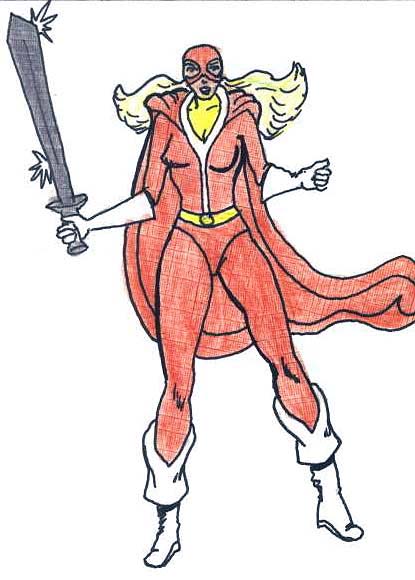
Ms Liberty, aka Linda Thorne. As a police officer, she intervened in a vicious attack on an alien child. The adult aliens gifted her with a sword in gratitude. The sword enabled Linda to fly and has numerous powers, including being able to shrink so that it is small enough to fit in a handbag. Also on the scene of the attack was the Freedom League’s Firebolt. He and Linda started a relationship, and the Freedom League helped her learn to use her alien weapon. She was a member of the Freedom League for some years, even after her relationship with Firebolt ended after he cheated on her with Vixen. In spite of that, she and Vixen became close friends and eventually decided to create a super powered team composed entirely of females. She appears in Eternal Flame and Obsidian’s Ark.


Eternal Flame

The Freedom League's numbers have dwindled to three - but leader Unicorn knows his team isn't finished yet. The turning point comes with Russell, a boy with bright red hair and a genetic variant ability to start fires. He's the first of an influx of new members who will take the League into the future. 

Judith and Wil are child prodigies - Judith in physics and electronics, and Wil in medicine. They have another thing in common - they are both genetic variants. And another thing - they both have fiery red hair. They are drawn to one another as their destinies intertwine, but the course of true love doesn't always run smoothly!

Richard is not a variant. He's an Olympic athlete who has picked up useful knowledge from his unusual friends to add to his own natural abilities. A chance encounter with a dying alien throws him into a Freedom League mission in which his skills are put to the ultimate test, along with theirs.

The Freedom League's arch-enemy, the super-villain Obsidian, wants his family fortune all to himself. One person stands in his way - his niece, Fiona. Fiona, devastated by a family tragedy and her failure to get in to her first choice university, is miserable and has few friends. When she realises her brother's death was no accident, and his killer is also after her, she fears it may be too late to gather allies around her and learn how to use her own genetic variant powers.

Available from Amazon and Amazon Kindle


Obsidian's Ark

Teenage years bring no end of problems. Daniel Moran's include getting hold of computer games his parents don't think he should have; a full blown crush on the beautiful Suki from Zorostan; maintaining his status as a prefect and getting his homework done. He must also keep from his parents and sister the fact that he is a superhero with a sword from another world.

Trish wonders how to get science whizz Tom to notice her; how to persuade him that the best way to stand up to the school bully is to fight back. She doesn't want her friends, especially not Tom, to know she is a genetic variant with superpowers. Little does she know that Tom has secrets of his own.


Suki struggles to make friends at school when she cannot understand everyday cultural references, and they all suspect her of being a terrorist. She, too, has a secret, but is it what her classmates assume?


When Daniel stumbles upon a plot by an alliance of supervillains to plunge the world into war, he tries to alert the established superheroes, but none of them believe him. When the Prime Minister's only daughter, Yasmin Miller, is abducted, Daniel knows the villains' plan is underway. It seems humanity's only hope may be Daniel and the ragtag bunch of teenage superheroes he recruits. Can he pull together, not only his own team, but the older heroes as well, in a bid to save the Earth from a devastating war?


Available from: