Thursday, 23 January 2020

24 January: Frederick the Great

Frederick the Great was King of Prussia from 1740 to 1786. His 46 year reign was the longest of any monarch of his dynasty, the Hohenzollerns. He was born on 24 January 1712.


Frederick the Great
  1. He wasn't the first Frederick to rule Prussia. His father was Frederick William I, also known as The Soldier King. His grandfather was Frederick I (hence Frederick the Great's regnal name was Frederick II). His mother was Sophia Dorothea of Hanover. Two years after Frederick was born, her father succeeded to the British throne as George I.
  2. Frederick William wanted his son to have a simple, practical education based on religion and military matters. However, Frederick became fond of poetry, Music and the arts and began collecting a library, much to his father's annoyance. Frederick was 28 when his father died and he succeeded the throne. While he and his father had never got on, Frederick admired him for his fairness, intelligence and skill in politics.
  3. It's generally accepted that Frederick the Great was gay. When he was 16, he became attached to his father's page, a 17 year old called Peter Karl Christoph von Keith. When his father found out, Keith was drafted into the army and sent to the Dutch frontier while Frederick was sent to his father's hunting lodge to "repent of his sin". A couple of years later he planned to run away to England with Hans Herman von Katte, one of his tutors. They were arrested and charged with treason, a capital offence. Frederick's father gave him a pardon, so he got away with merely losing his military rank, but Katte was beheaded and Frederick was forced to watch the execution. Frederick fainted. He would later write, "Fortune has it in for me; she is a woman, and I am not that way inclined."
  4. The solution, Frederick William decided, was to marry his son off. A couple of proposed alliances failed, but in the end, Frederick was married to Elizabeth Christine of Brunswick-Bevern. He knew he could never love her, or even become friends with her. He even considered killing himself, but in the end went along with it. However, when he became king he provided her with her own palace and apartments and rarely saw her.
  5. At the time, Machiavelli's work, The Prince, was the accepted blueprint for how a king should behave. Frederick didn't agree and wrote a book refuting it - Anti-Machiavel, which he had published anonymously.
  6. He could also write music. He composed several symphonies and pieces for the flute.
  7. As king, Frederick had to concentrate on politics and war rather than the arts. It was a learning curve - he made several tactical errors during his first battle as king, the Battle of Mollwitz, and almost lost. At one point he was advised to leave the battlefield because the Prussians were losing. He did, which led to embarrassment when they eventually won. He learned from his mistakes, though, with the help of one of the Prussian army commanders, Prince Eugene of Savoy. Unlike Frederick William, he could see that the young Frederick did have potential as a military leader, and mentored him. His interest in history helped here, too as he studied historical battles and their tactics, using them to win his own wars. He'd personally lead his forces into battle, so he was seen to be brave as well as a genius.
  8. His achievements as king weren't just limited to winning battles. He did a lot to build up the infrastructure of his kingdom, including the world's first public school system, leading to his people having one of the highest literacy rates in the world. He took an interest in agriculture, too, and introduced the Potato as a crop, solving the problem of food shortages. He also passed a law giving peasants the right to approach him to ask favours.
  9. He became known as an international statesman, too, with great powers coming to him for advice. America loved him, and after the War of Independence they asked him if his brother, Henry, could be made King of America. Frederick refused, knowing it would likely lead to a war with England or France. Napoleon was a great admirer of Frederick and studied his tactics. When he defeated the Prussians in 1806, Napoleon made a point of visiting Frederick's tomb, ordering his men to take off their hats, because, "If he were alive, we would not be here." Hitler, too, was a fan and had a picture of Frederick in his private rooms.
  10. Needless to say, he never had any children, but he loved Dogs. In fact, it's said he was the one who coined the phrase "man's best friend" to describe a dog. When he died, he was surrounded by his dogs. His last words were "cover the dog, he's shivering". He also requested that he be buried next to his dogs in his vineyard, but his nephew and successor, Frederick William II, ordered that his uncle be buried in the churchyard at Potsdam. Later, Hitler would have his coffin moved to a salt mine to protect it during WWII. However, in 1991, his body was finally laid to rest in the vineyard as per his wishes.


NEW!

Settling the Score
Another collection of short stories, even more murder and mayhem with carol singers, an orchestra out for revenge, a sinister magic stone and a haunted mansion.

Available on Amazon:
Paperback            E-book


A Tale of Two Sisters
During a battle with supervillains, a horrific accident leaves the Warner family with no option but to believe their youngest daughter, Jessica, is dead. It doesn't occur to them that the bad guys could, or would, save her.

Jessica wakes up with no memory of who she is or how she came to be on a space station with two bionic legs, a bionic arm and a bionic eye. She is told her family abandoned her and is sent back to Earth with a mission - to kill them. While Jessica wants to kill her family, along with the twin boys who once rejected her, she knows what the Alliance of Supervillains are asking her to do is a suicide mission. She decides to get her revenge in her own way.

As Jessica puts the first part of her revenge plan in motion, she finds herself with an agonising decision to make. Before she can decide, the Alliance come for her, determined to make her do their bidding. This time, it's the Alliance who leave her, crippled and at the mercy of the Warner family, who have no idea who the Alliance's Black Rose really is.

Jessica finds herself having to re-think her decisions in light of what she now learns about her family, the Alliance, the twins, and herself. It would appear the Alliance have left her with an unwanted and permanent reminder of her time with them. Or have they?

Jessica's older sister, Jill, knows her destiny is to be a doctor and specialise in bionics and genetic variant medicine. She is also hopelessly in love with Christopher, Crown Prince of Galorvia. Can their romance survive the lies Christopher told her when they were both at school, an unplanned pregnancy and Sophie, the wannabe princess who comes between them?

Available on Amazon
Paperback

E-book

Wednesday, 22 January 2020

23 January: Measure Your Feet Day

Today is Measure Your Feet Day. 10 facts about feet.


  1. A human foot has 26 bones (52 bones in both feet, almost a quarter of all the bones we have), 19 muscles, 10 tendons (including the Achilles tendon which is the strongest tendon in the human body) and 107 ligaments. There are also 8,000 nerves in our feet which is probably why feet are so ticklish, and 250,000 sweat glands capable of producing half a pint of sweat a day.
  2. The bones in a baby's foot are mostly cartilage. Our foot bones don't harden completely until the age of around 21.
  3. 20-30% of people have a second toe which is longer than their first. Enough that the condition has been given a name - Morton's Toe.
  4. One or two people in every thousand is born with more than their fair share of toes (and/or fingers). This condition is called polydactylism.
  5. Over the course of a normal day, your feet take a cumulative force of about 200 tons. As you walk, each foot takes one and a half times your body weight. When you run, that increases to up to five times your weight.
  6. Early humans had thicker and stronger toes than we do, because they walked barefoot. Go back even further and the big toe was like a thumb on the foot, which was useful to our tree climbing ancestors. Even today if a person loses one of their thumbs, transplanting one of their big toes onto their hand to replace it is an option that is open to them. Our feet continue to adapt. As humans in the Western world get bigger, their shoe sizes are getting larger, too.
  7. Women are four times more likely to have problems with their feet, which is put down to wearing high heels.
  8. Toenails grow at a rate of 1mm a month, much slower than fingernails. It takes five or six months, at least, to grow a completely new toenail. While on the subject of toenails, the record for the longest toenails is held by Louise Hollis of California, who has been growing her toenails since 1982. By 1991 she had toenails that were six inches long.
  9. Podophilia is another word for a foot fetish. The opposite, feeling extreme revulsion at the very thought of feet is podophobia.
  10. In 2003, scientists debunked the myth that there is a correlation between the size of a man's feet and the size of his penis. It is possible for a man to tell by looking at a woman's feet, whether she's interested in him or not. If her feet are positioned out and away from her body, he might just have pulled. If her feet are crossed or tucked beneath her, he may as well forget it. This phenomenon was not observed in men, however.

See also, Shoes and Socks.


NEW!

Settling the Score
Another collection of short stories, even more murder and mayhem with carol singers, an orchestra out for revenge, a sinister magic stone and a haunted mansion.

Available on Amazon:
Paperback            E-book


A Tale of Two Sisters
During a battle with supervillains, a horrific accident leaves the Warner family with no option but to believe their youngest daughter, Jessica, is dead. It doesn't occur to them that the bad guys could, or would, save her.

Jessica wakes up with no memory of who she is or how she came to be on a space station with two bionic legs, a bionic arm and a bionic eye. She is told her family abandoned her and is sent back to Earth with a mission - to kill them. While Jessica wants to kill her family, along with the twin boys who once rejected her, she knows what the Alliance of Supervillains are asking her to do is a suicide mission. She decides to get her revenge in her own way.

As Jessica puts the first part of her revenge plan in motion, she finds herself with an agonising decision to make. Before she can decide, the Alliance come for her, determined to make her do their bidding. This time, it's the Alliance who leave her, crippled and at the mercy of the Warner family, who have no idea who the Alliance's Black Rose really is.

Jessica finds herself having to re-think her decisions in light of what she now learns about her family, the Alliance, the twins, and herself. It would appear the Alliance have left her with an unwanted and permanent reminder of her time with them. Or have they?

Jessica's older sister, Jill, knows her destiny is to be a doctor and specialise in bionics and genetic variant medicine. She is also hopelessly in love with Christopher, Crown Prince of Galorvia. Can their romance survive the lies Christopher told her when they were both at school, an unplanned pregnancy and Sophie, the wannabe princess who comes between them?

Available on Amazon
Paperback

E-book

Tuesday, 21 January 2020

22 January: Lord Byron Quotes

This date in 1788 saw the birth of George Gordon Byron, Baron Byron of Rochdale. Here are some quotations from Lord Byron:

  1. Always laugh when you can. It is cheap medicine.
  2. Love will find a way through paths where wolves fear to prey.
  3. If I don't write to empty my mind, I go mad.
  4. You don't love a woman because she is beautiful, but she is beautiful because you love her.
  5. A drop of ink may make a million think.
  6. Good work and joyous play go hand in hand. When play stops, old age begins. Play keeps you from taking life too seriously.
  7. Hearts will break - yet brokenly, live on.
  8. There is music in all things, if men had ears.
  9. To have joy, one must share it.
  10. Friendship is Love without his wings!


NEW!

Settling the Score
Another collection of short stories, even more murder and mayhem with carol singers, an orchestra out for revenge, a sinister magic stone and a haunted mansion.

Available on Amazon:
Paperback            E-book


A Tale of Two Sisters
During a battle with supervillains, a horrific accident leaves the Warner family with no option but to believe their youngest daughter, Jessica, is dead. It doesn't occur to them that the bad guys could, or would, save her.

Jessica wakes up with no memory of who she is or how she came to be on a space station with two bionic legs, a bionic arm and a bionic eye. She is told her family abandoned her and is sent back to Earth with a mission - to kill them. While Jessica wants to kill her family, along with the twin boys who once rejected her, she knows what the Alliance of Supervillains are asking her to do is a suicide mission. She decides to get her revenge in her own way.

As Jessica puts the first part of her revenge plan in motion, she finds herself with an agonising decision to make. Before she can decide, the Alliance come for her, determined to make her do their bidding. This time, it's the Alliance who leave her, crippled and at the mercy of the Warner family, who have no idea who the Alliance's Black Rose really is.

Jessica finds herself having to re-think her decisions in light of what she now learns about her family, the Alliance, the twins, and herself. It would appear the Alliance have left her with an unwanted and permanent reminder of her time with them. Or have they?

Jessica's older sister, Jill, knows her destiny is to be a doctor and specialise in bionics and genetic variant medicine. She is also hopelessly in love with Christopher, Crown Prince of Galorvia. Can their romance survive the lies Christopher told her when they were both at school, an unplanned pregnancy and Sophie, the wannabe princess who comes between them?

Available on Amazon
Paperback

E-book

Monday, 20 January 2020

21 January: Tightrope walking

On the birthday of Karl Wallenda, ten things you might not know about tightrope walking.


  1. Another word for it is funambulism. That comes from the Greek, "funis" meaning rope and "ambulare", meaning to walk.
  2. In ancient Greece and Rome, people who could walk a tightrope were much admired, but the skill was never considered a sport, so it was never an Olympic event and stayed within the confines of entertainment.
  3. In France in the 5th century, rope walking was effectively banned - it was forbidden near churches - and most fairs, where such entertainment usually took place, were always held near churches. In the 17th and 18th century in England, tightrope walkers may not have been banned, but were generally thought to be disreputable types.
  4. Napoleon Bonaparte was a fan of tightrope walking - watching it, rather than doing it! In his time there was a famous funambulist called Madame Saqui, who performed for Napoleon many times, with a backdrop of fireworks. When Napoleon's heir was born, she was part of the celebration. On that occasion she walked a wire between the towers of Notre Dame Cathedral. She carried on working into her 70s and gets a mention in Thackeray's novel, Vanity Fair.
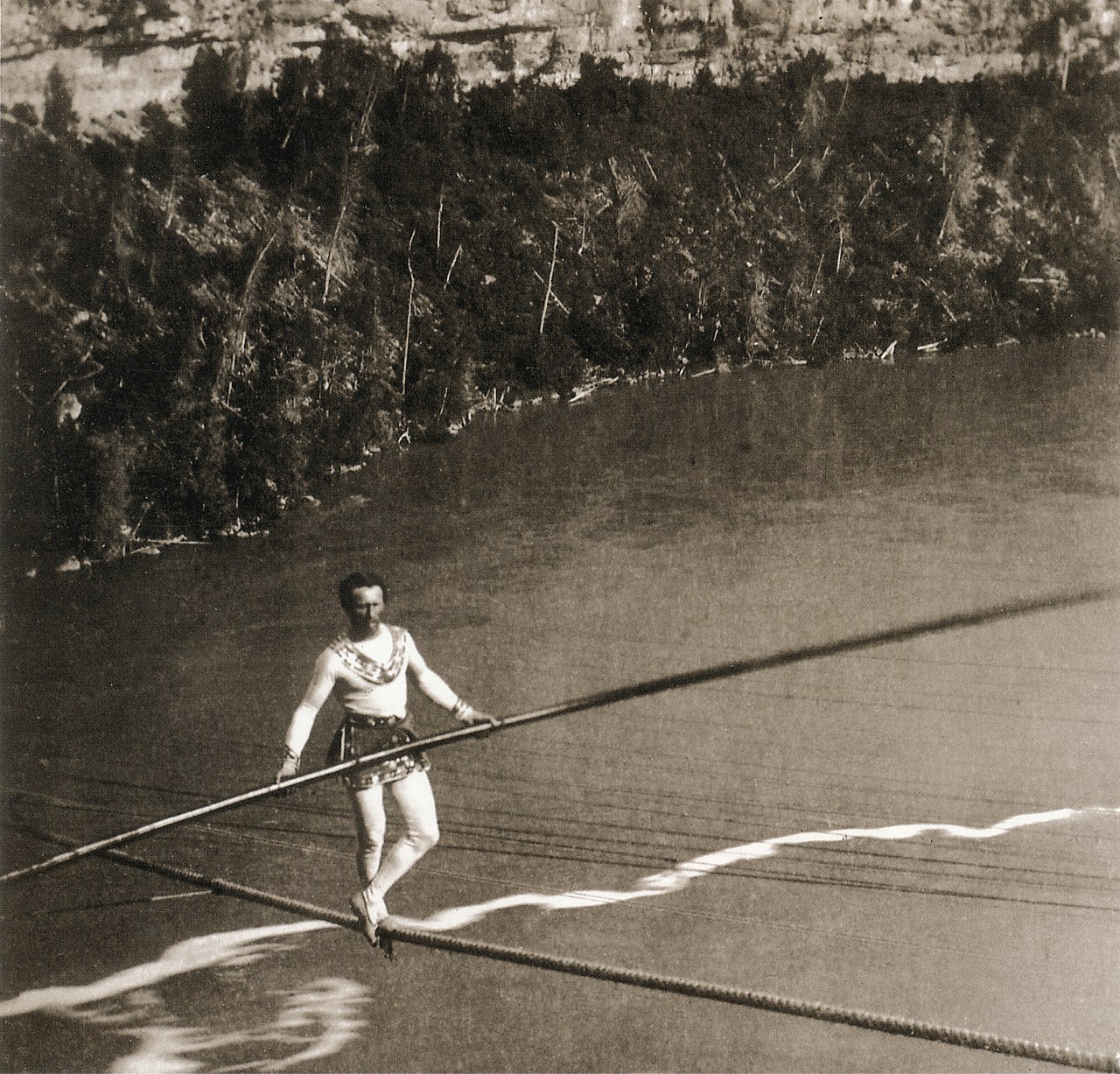
  5. The first person to walk a tightrope across Niagara Falls was The Great Blondin, in 1859. He stopped halfway across to drink a Beer. He performed the stunt several more times, doing ever more crazy stunts like riding a Bicycle across, stopping in the middle to cook an omelette and carrying his manager across on his back. One of his contemporaries, the Great Farini, carried a Washing machine on his back as he walked over the Falls on a tightrope, pausing in the middle to wash some handkerchiefs, which he gave out to fans at the end.
  6. The first person to walk across the Grand Canyon on a tightrope was Nik Wallenda, Karl's great-grandson, in 2013.
  7. There are different types of rope or wire walking. Tightwire is walking along a rope or wire tensioned between two points, possibly using an Umbrella or a pole for balance, and including tricks such as juggling as they walk. Highwire is similar, only higher up. There's no official point where tightwire becomes highwire but generally if the rope/wire is more than 20 feet/6 metres off the ground, it's highwire. Skywalk is crossing a wire at even greater heights, such as between two buildings or across a canyon. There's also such a thing as slackwire walking, where the rope or wire is more flexible. The methods of balance between the two are completely different.
  8. What a tightrope walker must do in order not to fall, is lower their centre of gravity. not by leaning forward, because this alters a person's sense of location, but by standing up straight and bending the knees, bringing the hips closer to the wire.
  9. The process is made even harder by the fact that the rope or wire will rotate with each step, so the walker must increase their rotational inertia by positioning their body to fight against the tendency of the rope to rotate. Using a pole as a balance tool helps with this.
  10. I'll finish with some world records. The longest tightrope walk ever was 130m achieved by American Bello Nock in 2010. It took him 15 minutes to walk the rope, attached to poles on board a cruise liner. The highest was achieved by Freddy Nock (from Switzerland - I could find no evidence the two are related) in 2015 when he walked a rope between two mountains in Switzerland. Freddy also holds the record for the fastest tightrope walk between two Hot air balloons. Maurizio Zavatta, from Italy, holds the record for the fastest 100m tightrope walk - backwards. He did it in 1min 57 seconds in 2014.


A Tale of Two Sisters

During a battle with supervillains, a horrific accident leaves the Warner family with no option but to believe their youngest daughter, Jessica, is dead. It doesn't occur to them that the bad guys could, or would, save her.

Jessica wakes up with no memory of who she is or how she came to be on a space station with two bionic legs, a bionic arm and a bionic eye. She is told her family abandoned her and is sent back to Earth with a mission - to kill them. While Jessica wants to kill her family, along with the twin boys who once rejected her, she knows what the Alliance of Supervillains are asking her to do is a suicide mission. She decides to get her revenge in her own way.

As Jessica puts the first part of her revenge plan in motion, she finds herself with an agonising decision to make. Before she can decide, the Alliance come for her, determined to make her do their bidding. This time, it's the Alliance who leave her, crippled and at the mercy of the Warner family, who have no idea who the Alliance's Black Rose really is.

Jessica finds herself having to re-think her decisions in light of what she now learns about her family, the Alliance, the twins, and herself. It would appear the Alliance have left her with an unwanted and permanent reminder of her time with them. Or have they?

Jessica's older sister, Jill, knows her destiny is to be a doctor and specialise in bionics and genetic variant medicine. She is also hopelessly in love with Christopher, Crown Prince of Galorvia. Can their romance survive the lies Christopher told her when they were both at school, an unplanned pregnancy and Sophie, the wannabe princess who comes between them?
Available on Amazon
Paperback

E-book

20 January: Blue Day

Today is Blue Day. Blue is the colour we see when light with a wavelength of about 450-495 nanometres hits our eyes. Ten more things you might not know about the colour blue.

  1. Feeling blue? Using the word blue to mean downcast and depressed dates to the 15th century. It's thought to have derived from the bluish tinge a person's skin gets when their circulation is poor or they are deprived of Oxygen.
  2. In the Bible, the colour blue is mentioned 34 times in the book of Exodus. There are only 15 other mentions of blue in the Good Book, none of which are in the New Testament.
  3. Mosquitoes are thought to be particularly attracted to the colour blue.
  4. Blue pigments for painting were first made from minerals like lapis lazuli and azurite, ground into powder and mixed with oil or egg white. Cobalt was used to make blue for stained glass, while dyes for fabrics were made from woad and indigo. In the middle ages, only poor people wore blue, because they could only afford poor quality woad dyes. In Italy, only one guild of clothmakers was allowed to use blue dye. There were severe penalties if anyone else did it.
  5. The making of woad dye was particularly disgusting. The leaves of the woad plant would be soaked in human urine for up to a week, ideally pee from men who'd been drinking a lot. Then the fabric would be steeped in this mixture for a day and left to dry in the Sun, where it would turn blue as it dried.
  6. The sky and the sea appear blue because blue has a short wavelength relative to other colours and gets more scattered by the oxygen and nitrogen in the atmosphere, or in water, so more of it hits our eyes. The phenomenon is known as Raleigh scattering after the scientist who discovered it. The same principle is at work in people with blue eyes. There is no blue pigment in their eyes, just less melanin, which means blue light is not absorbed but reflected so the eyes appear blue. Distant mountains look blue because of something called atmospheric perspective in which the further away something is, the less contrast it has with its surroundings, usually a blue sky. Hence in art if something is painted blue, it appears to be further away than objects painted in Green or red.
  7. In surveys, over half the respondents say blue is their favourite colour. People associate it with harmony, faithfulness ("true blue"), masculinity, confidence, infinity, cold, calm and concentration.
  8. Blue was seen by Muslims as a much less important colour than green, which was said to be Mohammed's favourite. There was a law in Moorish Spain which said only Muslims could wear green or white, so Christians and Jews would wear blue. Perhaps that's one reason why the Virgin Mary is so often depicted in blue - another is that blue pigments such as ultramarine were the most expensive - only the best for the Virgin Mary. While today we see blue as a colour for boys, as recently as the early 1900s it was the colour for girls, because of its association with the Virgin Mary.
  9. Police uniforms are blue because Robert Peel designed the jackets of his original police force in dark blue so they would look different to the red jackets of the soldiers who had been responsible for law and order before that.
  10. In Turkey, blue is the colour of mourning. In China, it's associated with ghosts, death and torment, and the villain in Chinese opera will wear blue make up. In Thailand, the colour blue is associated with Fridays. Any person born on a Friday can adopt blue as their colour.


NEW!


A Tale of Two Sisters

During a battle with supervillains, a horrific accident leaves the Warner family with no option but to believe their youngest daughter, Jessica, is dead. It doesn't occur to them that the bad guys could, or would, save her.

Jessica wakes up with no memory of who she is or how she came to be on a space station with two bionic legs, a bionic arm and a bionic eye. She is told her family abandoned her and is sent back to Earth with a mission - to kill them. While Jessica wants to kill her family, along with the twin boys who once rejected her, she knows what the Alliance of Supervillains are asking her to do is a suicide mission. She decides to get her revenge in her own way.

As Jessica puts the first part of her revenge plan in motion, she finds herself with an agonising decision to make. Before she can decide, the Alliance come for her, determined to make her do their bidding. This time, it's the Alliance who leave her, crippled and at the mercy of the Warner family, who have no idea who the Alliance's Black Rose really is.

Jessica finds herself having to re-think her decisions in light of what she now learns about her family, the Alliance, the twins, and herself. It would appear the Alliance have left her with an unwanted and permanent reminder of her time with them. Or have they?

Jessica's older sister, Jill, knows her destiny is to be a doctor and specialise in bionics and genetic variant medicine. She is also hopelessly in love with Christopher, Crown Prince of Galorvia. Can their romance survive the lies Christopher told her when they were both at school, an unplanned pregnancy and Sophie, the wannabe princess who comes between them?

Available on Amazon
Paperback

E-book


Saturday, 18 January 2020

19 January: Ravens

Edgar Allan Poe's birthday seemed like a good day to share ten facts about Ravens.

  1. The scientific name for the common raven is Corvus corax.
  2. They're highly intelligent, and playful. They've been observed sliding down roofs and hillsides after Snow, and they use found objects such as pine cones or sticks as toys, playing by themselves or with other ravens. They are among the most intelligent birds in the world and are said to be as bright as Dolphins or Chimpanzees. One study found they were more intelligent than small human children, because they figured out that they could get food out of a narrow space by bending a piece of wire into a hook. The toddlers didn't, and presumably just threw a tantrum. Ravens can also match flash cards for food with minimal training.
  3. They can imitate human voices, animal calls and other sounds, such as flushing Toilets or car engines. So Edgar Allan Poe's raven could quite easily have said, "nevermore". Among themselves, they make a wide range of sounds which have meanings, including one specific sound that means food. They can even use sounds to express emotions and have dialects within their social groups.
  4. There are plenty of myths and superstitions attached to ravens. Many cultures see them as messengers of the gods, or, in the case of Odin, their spies. Odin's ravens, Hugin and Munin (thought and memory) flew around the world each day and reported back to Odin each night, telling him what was going on in the human world. A Chinese superstition says that ravens cause bad weather as a warning that one of the gods is about to pay a visit. Some Native American tribes believe the raven is a god, who was involved in the creation of the world. In some parts of the world, they're seen as evil. In France, ravens were said to be the souls of wicked priests, and in Germany, they were damned souls. Satan himself. In Sweden, a raven calling at night was said to be the soul of a murder victim who didn't get a proper burial. A raven could even be an incarnation of Satan himself, or an exorcised spirit. In Denmark, if a raven flies overhead, it's inadvisable to look up at it, because if it has a hole in its wing, it can turn the observer into a raven. In Ireland, they were said to be omens of battle, and the war goddess would summon ravens to feast on those killed in battle. As scavengers, however, to do so would be within the range of their natural behaviour.
  5. In the UK, there are ravens at the Tower of London, and it's said that if ever they leave, the monarchy will fall. Charles II decided not to take any chances and decreed that six ravens must be kept there at all times. While the ravens living there may have their wings clipped to stop them flying away, they are well looked after.
  6. They're sociable, and have been shown to recognise other ravens up to three years after they last saw them, but act suspiciously towards strange ravens. They've even been observed showing empathy to one another. If a raven loses a fight, its friends will appear to comfort it. They're even capable of recognising humans. One experiment had a researcher eating a piece of Cheese instead of giving it to the birds - and they remembered, and would choose to go to a new researcher rather than the one who'd cheated them out of their cheese.
  7. They're not only sociable with other ravens but with other animals, too. They've been observed to hang out with Wolves. The wolves kill a large animal and the ravens home in on the kill and can make off with as much as 40% of it, depending on the number of wolves involved. Scientists believe that is why wolves evolved to hunt in packs. The ravens don't just steal food, however - they will lead the wolves to dead animals they can't eat themselves because their beaks aren't strong enough to break into the carcass (though no doubt they do help themselves once the wolves have torn it apart). They also act as lookouts and will alert the gorging wolves to any potential danger.
  8. Ravens seem to love smashing up Ants and rubbing them on their bodies. Nobody knows why they do this. The behaviour, known as "anting" isn't specific to ravens - other birds in the Corvis family do it, too. There are plenty of theories. Smashing up ants produces formic acid and what the bird is doing is boosting its immunity to formic acid so it can eat the ants with no ill effects; the formic acid has some soothing effect on their skin; or it gets them high, like a drug.
  9. The word for a group of ravens is an unkindness.
  10. Are ravens and Crows the same thing? No. How can you tell the difference? Ravens are bigger. They have longer tail feathers and larger beaks.


NEW!


A Tale of Two Sisters

During a battle with supervillains, a horrific accident leaves the Warner family with no option but to believe their youngest daughter, Jessica, is dead. It doesn't occur to them that the bad guys could, or would, save her.

Jessica wakes up with no memory of who she is or how she came to be on a space station with two bionic legs, a bionic arm and a bionic eye. She is told her family abandoned her and is sent back to Earth with a mission - to kill them. While Jessica wants to kill her family, along with the twin boys who once rejected her, she knows what the Alliance of Supervillains are asking her to do is a suicide mission. She decides to get her revenge in her own way.

As Jessica puts the first part of her revenge plan in motion, she finds herself with an agonising decision to make. Before she can decide, the Alliance come for her, determined to make her do their bidding. This time, it's the Alliance who leave her, crippled and at the mercy of the Warner family, who have no idea who the Alliance's Black Rose really is.

Jessica finds herself having to re-think her decisions in light of what she now learns about her family, the Alliance, the twins, and herself. It would appear the Alliance have left her with an unwanted and permanent reminder of her time with them. Or have they?

Jessica's older sister, Jill, knows her destiny is to be a doctor and specialise in bionics and genetic variant medicine. She is also hopelessly in love with Christopher, Crown Prince of Galorvia. Can their romance survive the lies Christopher told her when they were both at school, an unplanned pregnancy and Sophie, the wannabe princess who comes between them?

Available on Amazon
Paperback

E-book


Friday, 17 January 2020

18 January: National Thesaurus Day

Today is National Thesaurus Day, commemorating the birth in 1779 of Peter Mark Roget, doctor and lexicographer, who produced his Thesaurus in 1852 after 47 years’ work. 

  1. The first modern Thesaurus was written by a British doctor named Peter Mark Roget, who was born on 18 January 1779, which is why this date was chosen as National Thesaurus Day. He started compiling lists of words and grouping them according to meaning when he was about 35, but didn't publish them until 1852, after he'd retired as a doctor. He called it by the snappy title of Thesaurus of English words and phrases; so classified and arranged as to facilitate the expression of ideas and assist in literary composition.
  2. Roget's original thesaurus contained 15,000 words, but each new edition has been larger as new words are added, but the classifications stay faithful to those Roget established.
  3. The first thesaurus was compiled in the late 1st century, in Greek, by Philo of Byblos. He called his work On Synonyms. Sadly, no copies of it have survived.
  4. The oldest Thesaurus which still exists originated in India. In the 4th century, Amara Sinha wrote a thesaurus of Sanskrit words in the form of a poem, and called it The Amarakosha. It was written in verse to help people memorise the words.
  5. The word Thesaurus derives from the Greek word theasuros, which means a treasure store.
  6. If you have more than one of them, should you refer to your collection as thesauri or thesauruses? Technically, it should be thesauri, but either is acceptable these days.
  7. Peter Mark Roget wasn't just interested in words - he also invented the log-log slide rule. He was an avid Chess player, too, and solved a tricky chess problem called the knight's tour problem - how to move the knight so it visits every square on a chessboard; and invented a pocket chessboard. Don't get him started on phrenology, though (measuring bumps on the skull and linking them to personality traits) because he once worte a two volume book denouncing it.
  8. There is an artist in America who turns the thesaurus into art by painting lists of English and Yiddish synonyms onto canvas. His works include lists of expressions meaning "crazy" and "die".
  9. Roget's Thesaurus may be the best known book of its type but there are others. The Oxford English dictionary produced one in two volumes. Volume two is the index, and it's longer than the thesaurus itself. There's also a thesaurus of slang words.
  10. JM Barrie once said that Captain Hook could not be wholly evil because he had a thesaurus in his cabin.


NEW!


A Tale of Two Sisters

During a battle with supervillains, a horrific accident leaves the Warner family with no option but to believe their youngest daughter, Jessica, is dead. It doesn't occur to them that the bad guys could, or would, save her.

Jessica wakes up with no memory of who she is or how she came to be on a space station with two bionic legs, a bionic arm and a bionic eye. She is told her family abandoned her and is sent back to Earth with a mission - to kill them. While Jessica wants to kill her family, along with the twin boys who once rejected her, she knows what the Alliance of Supervillains are asking her to do is a suicide mission. She decides to get her revenge in her own way.

As Jessica puts the first part of her revenge plan in motion, she finds herself with an agonising decision to make. Before she can decide, the Alliance come for her, determined to make her do their bidding. This time, it's the Alliance who leave her, crippled and at the mercy of the Warner family, who have no idea who the Alliance's Black Rose really is.

Jessica finds herself having to re-think her decisions in light of what she now learns about her family, the Alliance, the twins, and herself. It would appear the Alliance have left her with an unwanted and permanent reminder of her time with them. Or have they?

Jessica's older sister, Jill, knows her destiny is to be a doctor and specialise in bionics and genetic variant medicine. She is also hopelessly in love with Christopher, Crown Prince of Galorvia. Can their romance survive the lies Christopher told her when they were both at school, an unplanned pregnancy and Sophie, the wannabe princess who comes between them?

Available on Amazon
Paperback

E-book