Saturday, 7 January 2017

7th January: The River Thames

On this date in 1928 fourteen people were drowned in London and thousands made homeless when the Thames Embankment and part of the Chelsea Embankment collapsed. It was the last major flood to affect central London. Here are some facts about the river Thames.


  1. The Thames is 346 km (215 miles) long and is the longest river which is entirely in England. It's the second longest in the UK - the Severn is longer.
  2. There are several places which claim to be the source - including Thames Head in Gloucestershire and Seven Springs, Gloucestershire. Ordnance Survey says it is at Trewsbury Mead.
  3. The river was called Tamesas by the Celts, and Tamesis by the Romans. The name is thought to mean "dark". Similar words meaning "dark" occur in several languages including Irish, Welsh, Russian and even Sanskrit. The bit of the river which flows through Oxford is historically called the Isis, and there were cartographers in the Victorian era who thought the entire river should be called that, at least up to the point where it is joined by its tributary the Thame and becomes the "Thame-isis". In ancient times, the part of the river in what is now London also had a different name - Plowonida, meaning "flowing river". It was the part which was too wide to ford. The name was give to a settlement on the banks, which the Romans Latinised as Londinium - so London was quite possibly named after its river.
  4. The river has over 80 islands, 200 bridges, 44 locks, six ferry crossings, more than 20 tunnels and a cable car crossing. There are more than 37 rowing clubs along its length. It meanders through several counties: Gloucestershire, Wiltshire, Oxfordshire, Berkshire, Buckinghamshire, Surrey, Essex, Kent and Greater London. It is policed by five different police forces, and there are four lifeboat stations.
  5. Looking at the river as it flows through London, one would be forgiven for thinking no-one in their right mind would drink the Water - however, two thirds of London's drinking water comes from the Thames (purified first, thankfully). It is said that a drop of rain falling into the Thames at its source in the Cotswolds will be drunk by at least eight people before it flows into the Thames Estuary.
  6. Before 1865, most of the city's waste was dumped into the river. In 1858, the stench from all the sewage in the river was so bad that Parliament had to be suspended. It was “The Great Stink” that convinced parliament that London needed a sewer system.
  7. From Teddington down to the sea the river is tidal with a tidal range of 7 metres (23 ft).
  8. Roughly one dead body a week is fished out of the river by police - mostly suicides. In 1795, Mary Wollstonecraft (feminist and mother of Mary Shelley), threw herself off of Putney Bridge after her lover left her for an actress. She was pulled out of the river by a boatman. She wasn't dead, however, just unconscious and lived to tell the tale.
  9. The Luftwaffe used the Thames to navigate to London – as soon as they saw the distinctive u-bend they knew that they were at the docks. While many people drained their ponds and pools there was not much they could do about the river!
  10. In 2006 Lewis Pugh became the first person to swim the full length of the Thames from outside Kemble to Southend-on-Sea to raise awareness of global warming. It took him 21 days, although he had to run the first bit as a drought had stopped the river from flowing near to the source. Since then, in 2011 comedian David Walliams swam the 140 miles (230 km) from Lechlade to Westminster Bridge and raised over £1 million for charity.

I write fiction, too!

If you're doing one of those reading challenges, I could be your self-published author, your female author, or your out of your comfort zone book. There are books published in the last year, most set in the UK and one with a place name in the title.


Friday, 6 January 2017

January 6th: Kahlil Gibran

January 6th 1883 was the birthdate of the poet Kahlil Gibran. Here are ten quotes from him.

  1. Forget not that the earth delights to feel your bare feet and the winds long to play with your hair.
  2. Out of suffering have emerged the strongest souls; the most massive characters are seared with scars.
  3. You give but little when you give of your possessions. It is when you give of yourself that you truly give.
  4. If you love somebody, let them go, for if they return, they were always yours. And if they don't, they never were.
  5. But let there be spaces in your togetherness and let the winds of the heavens dance between you. Love one another but make not a bond of love: let it rather be a moving sea between the shores of your souls.
  6. Yesterday is but today's memory, and tomorrow is today's dream.
  7. Progress lies not in enhancing what is, but in advancing toward what will be.
  8. Generosity is giving more than you can, and pride is taking less than you need.
  9. Perplexity is the beginning of knowledge.
  10. Say not, 'I have found the truth,' but rather, 'I have found a truth.'

I write fiction, too!

If you're doing one of those reading challenges, I could be your self-published author, your female author, or your out of your comfort zone book. There are books published in the last year, most set in the UK and one with a place name in the title.

Thursday, 5 January 2017

5th January: Umberto Eco

Umberto Eco, the writer whose most famous book is Name of the Rose. was born on this date in 1932. Here are ten Umberto Eco quotes.


  1. Nothing gives a fearful man more courage than another's fear.
  2. The real hero is always a hero by mistake; he dreams of being an honest coward like everybody else.
  3. Because of lies, we can produce and invent a possible world.
  4. When one starts writing a book, especially a novel, even the humblest person in the world hopes to become Homer.
  5. Beauty is boring because it is predictable.
  6. I believe that what we become depends on what our fathers teach us at odd moments, when they aren't trying to teach us. We are formed by little scraps of wisdom.
  7. Absence is to love as wind is to fire: it extinguishes the little flame, it fans the big.
  8. When you are on the dancefloor, there is nothing to do but dance.
  9. Love is wiser than wisdom.
  10. When the writer (or the artist in general) says he has worked without giving any thought to the rules of the process, he simply means he was working without realising he knew the rules.


I write fiction, too!

If you're doing one of those reading challenges, I could be your self-published author, your female author, or your out of your comfort zone book. There are books published in the last year, most set in the UK and one with a place name in the title.

Wednesday, 4 January 2017

4th January: Sir Isaac Pitman

Today is the birthdate of Sir Isaac Pitman, who invented shorthand. He was born in 1813.

  1. Isaac Pitman was born in Trowbridge in Wiltshire. He was the third of eleven children born to mill manager Samuel Pitman and his wife, Maria.
  2. From the age of thirteen, he was home schooled. He had to leave the local grammar school because of his health - the overcrowded classrooms gave him fainting fits.
  3. He must have overcome this health problem eventually, for after leaving school he went to the Training College of the British and Foreign School Society, which in those days took all of five months. He was a teacher in Barton-upon-Humber, Lincolnshire and Wotton-under-Edge, Gloucestershire. He later started his own school in Bath, where he lived in Royal Crescent.
  4. He opened his own school because he'd been fired from the previous one, for holding unconventional religious beliefs. He was a Swedenborgian, a movement which believed in the writings of the scientist and theologian Emmanuel Swedenbourg, who claimed to have received a new revelation from Jesus Christ through heavenly over a period of at least twenty-five years. He was one of the founding members of a Swedenborgian church in Bath and remained active until he died. The church had a stained glass Window dedicated to him in 1909.
  5. One of Pitman's lifelong passions was spelling reform. He believed spelling in the English language should be made simpler and based on the sounds of the words. He published numerous pamphlets on the subject. This interest resulted directly in his phonetic shorthand system which was first published in a pamphlet in 1837. He believed in spelling reform so strongly that in the 1881 Census, he entered his name as "Eisak Pitman".
  6. His motto was "time saved is life gained".
  7. In 1843, he left the teaching profession and went into publishing and printing full time. His company, Isaac Pitman and Sons, would become one of the world's leading educational publishers and training businesses with offices in London, Bath, New York City, Melbourne, Johannesburg, Toronto and Tokyo. With the introduction of uniform postage rates across the UK in 1840, Pitman came up with the idea of the correspondence course as a way for people to learn shorthand - students would transcribe texts into shorthand onto a postcard and send them to Pitman to be marked. The training business evolved into two separate businesses: Pitman Training and JHP Training (now learndirect).
  8. His shorthand system became very popular with journalists, coming at a time of expansion in the Newspaper industry. It made their work a whole lot easier.
  9. At the age of about 24, Pitman gave up drinking alcohol and became a vegetarian the following year. He claimed being a tee-total vegetarian was the reason for his good health and ability to work long hours. He was vice president of the Vegetarian Society.
  10. His memorial plaque on the north wall of Bath Abbey reads, "His aims were steadfast, his mind original, his work prodigious, the achievement world-wide. His life was ordered in service to God and duty to man."

I write fiction, too!

If you're doing one of those reading challenges, I could be your self-published author, your female author, or your out of your comfort zone book. There are books published in the last year, most set in the UK and one with a place name in the title.

Tuesday, 3 January 2017

3rd January: San Francisco

The California town of Yerba Buena was renamed on this date in 1848. Its new name? San Francisco. 

  1. San Francisco was originally named Yerba Buena, meaning "good herb" after the wild Mint which grew nearby. The first mayor changed the town's name in 1848, naming it after a mission dedicated to St Francis of Assisi. It has several nicknames, including "The City by the Bay", "Fog City", "San Fran", and "Frisco", "The City that Knows How", "Baghdad by the Bay", "The Paris of the West", or simply "The City".
  2. As cities go, it's relatively small - seven miles long by seven miles wide, with a population of around 830,000. The people must like to eat out, as there are are more than 3,500 restaurants open in the city at any one time.
  3. One thing the city is famous for is the massive Earthquake in 1906, the first natural disaster to be photographed. Contrary to popular belief, most of the damage wasn't done by the earthquake itself, but by the fires which started afterwards. There are hundreds of earthquakes in the area every year, but the vast majority are so small you can't feel them. All the same, buildings are designed to withstand bigger quakes, including the airport, which is supported by 267 columns that each rest on a steel ball bearing, allowing the ground to move 20 inches in any direction during an earthquake. It's said that the names of streets (complete with spelling mistakes) are stamped onto the sidewalks so people can find their way after a big quake when all the other signs have fallen down. In fact, the sidewalk stamps pre-dated any other signs - it was simply the way streets were labelled in the early days.
  4. The city is built on more than 50 hills. Some of the best known are Russian Hill, Nob Hill, Telegraph Hill, Twin Peaks, Golden Mine Hill, Excelsior Heights, and Tank Hill, but there are more than 50 hills with names.
  5. San Francisco has the only National Historic Landmark that moves - the Cable Cars, which run at 9.5 miles an hour.
  6. Lombard Street in San Francisco is known for being “the crookedest street in the world.” Locals will tell you that Vermont Street in Potrero Hill is crookeder. It has less turns, but it's steeper.
  7. Famous people from the city include Clint Eastwood, Bruce Lee, Alicia Silverstone, Natalie Wood, Jerry Garcia, Robert Frost and the eccentric Joshua Abraham Norton, who proclaimed himself Emperor of the United States in 1859. Inventions which started life here include the Fortune cookie (first served by Makoto Hagiwara in his tea garden in the late 1890s), denim jeans (created for the Gold rush miners who needed tough, durable clothing), the bendy Drinking Straw (Joseph B. Friedman invented this after his daughter had difficulty drinking with a straight one). The first television image was transmitted in San Francisco on September 7, 1927 by Philo Taylor Farnsworth.
  8. San Francisco Bay is only as deep as a swimming pool at approximately 12-15 feet deep on average. Large ships can only navigate it through a deep channel which is maintained by regular dredging. Another misconception about the bay is that it is infested with man-eating Sharks. There are sharks living in the bay, but only small, harmless ones. The Great Whites live out in the Pacific Ocean and rarely pay a visit.
  9. It is illegal to beat a rug clean outside your home in San Francisco. It's also illegal to bury people within the city limits and has been since 1902, because there's not enough room. They even moved most of the existing graves out of the city, so only two cemeteries remain - the Mission San Francisco de Asis and the National Cemetery in the Presidio. There was even a law once making it illegal for ugly people to show themselves in public, but that one was repealed.
  10. The  Accordion is San Francisco's official musical instrument. That's a relatively modern thing - the Board of Supervisors voted for this in 1990.


Monday, 2 January 2017

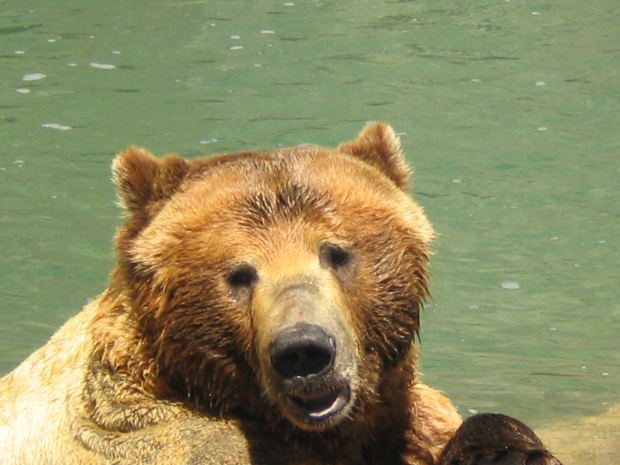
2nd January: Grizzly bears

On this date in 1975, the US Department of Interior designated the grizzly bear a threatened species. Here are some things you might not know about bears.

  1. The Grizzly bear is basically what they call the brown bear, Ursus arctos, in North America. Scientists do not use the name grizzly bear but call it the North American brown bear.
  2. The name "grizzly" was coined by the famous US explorers, Lewis and Clark. This may have been because the bears had a grizzled appearance, or because they were terrifying - historians are not sure.
  3. Bears are omnivores. Meat is a very important part of their diet. They eat fish, such as Salmon, and prey on large mammals, usually injured individuals or young. They will also scavenge and eat carrion. Brown bears in coastal areas have been known to eat beached Whales. They also eat plants, particularly berries.
  4. A female grizzly can weigh up to 180 kg (400 lb) and a male 360 kg (790 lb). On average they are 198 cm (6.50 ft) long with a shoulder height of 102 cm (3.35 ft). Standing on hind legs, they can be as much as 3 metres (9.8 ft) tall. Their front claws can be four inches long. Canadian and Alaskan bears are generally bigger because they have a better diet.
  5. Brown bears originated in Eurasia and travelled to North America approximately 50,000 years ago.
  6. There are only about 1,500 grizzly bears left in mainland United States. Of these, 800 live in Montana. They are a protected species in the USA, Mexico and in parts of Canada and Europe.
  7. Bears do not normally prey on humans, even though they could if they wanted to. They avoid people as a rule. in 70% of cases where a human is killed by a grizzly it is by a female defending her cubs. Otherwise it may be because people have taken a bear by surprise, or because it thinks the human is going to take its food. Bear awareness programs have been developed by numerous towns in British Columbia, Canada, to stop bears from becoming a problem. People are told to keep their rubbish securely stowed, harvest fruit as soon as it's ripe and keep livestock behind electric fences, so bears will not venture into inhabited areas looking for food. Bears that become dependent on food left out by humans usually have to be killed.
  8. It has been estimated that a bite from a grizzly could crush a bowling ball.
  9. Grizzly bears living in colder climates hibernate for 5–7 months each year. Those living where it is warmer and food is plentiful all year round, may not. Bears prepare for hibernation by eating as much as they can, and making a den. Dens are usually at elevations above 1,800m (5,900 ft) and on north-facing slopes. The first substantial snowstorm in winter usually marks the start of hibernation - the Snow makes the den harder for any predators to find. Females give birth to their cubs while hibernating.
  10. In the wild, a male grizzly may live about 22 years and females 26 years. Females live longer because the males risk their lives fighting over the females. Captive grizzlies have lived as long as 44 years.

Sunday, 1 January 2017

1st January: Janus

Following on from Hecate yesterday, the goddess of crossroads, doorways and places in between, today we have Janus, the Roman god of beginnings. Welcome to 2017.


  1. Janus is usually depicted as having two faces, one looking forward and one looking back, signifying that he can see both the past and the future.
  2. His sphere of influence encompasses Beginnings, doors, gates, roadways, passageways, birth, travel, trading and shipping. He's also associated with omens and auspices.
  3. He is thought to be one of the oldest of the Roman gods, and the one responsible for lifting man out of his savage state and into civilization.
  4. He was certainly a very important god in Roman times. Not only was he honoured and worshiped at the beginnings of things - the new year, planting of crops, weddings, and so on, he was worshiped first at every ritual performed for any reason. No matter which other god was being invoked or prayed to, the ceremony always started with an invocation to Janus. Incidentally, every ceremony would end with a corresponding invocation to Vesta, goddess of hearth and home. The rule was "Janus primus and Vesta extrema".
  5. Not only that, but instead of having dedicated priests, the King of the Sacred Rites (rex sacrorum) himself presided over the rites of Janus.
  6. The symbols of Janus are a key and a staff.
  7. Janus is unusual in that, unlike other Roman gods, he has no Greek equivalent.
  8. Janus was thought to have introduced the practice of minting coins to the Romans and his effigy is found on many Roman coins.
  9. The beginning and endings of wars were part of Janus' domain. The doors of his temple were open when there was a war on, and closed in times of peace. In Roman times, there was pretty much always a war on, so the doors weren't closed very often. Sacrifices and rituals to forecast the outcome of the war would be held in the temple. In peacetime, the doors were closed to contain the spirit of war inside and preserve the peace.
  10. The month of January is named after Janus. Another English word which derives from his name is "janitor", which derives from the Latin word for door, "ianua", which in turn comes from the name of the god.