Thursday, 7 January 2016

7th January: Tarzan

On this date in 1929, the first Tarzan comic strip appeared. Here are some things you may not know about Tarzan of the Apes:

  1. Tarzan's real English name is John Clayton, Viscount Greystoke.
  2. His ape name, Tarzan, means "white skin". Burroughs considered other names including "Zantar" and "Tublat Zan".
  3. His parents were marooned on the Atlantic coast of Africa by mutineers. When Tarzan was a baby, his mother died, and his father was killed by Kerchak, leader of the ape tribe by whom Tarzan was adopted.
  4. Tarzan was adopted by a species of talking ape unknown to science (ie fictional) called the Mangani. The word means "great-ape" and is used by the apes to describe themselves, their language, and even humans. Science fiction author Philip José Farmer has speculated they might be a variety of Australopithecus.
  5. Tarzan is highly intelligent, and as a teenager, taught himself to read English with the books his parents had brought with them in order to home school him. He didn't learn how to speak English aloud until he met some English speaking people. In the books, he speaks perfect English rather than the "Me Tarzan, You Jane" style broken English used in the films.
  6. Tarzan's love interest, Jane, is Jane Porter from Baltimore, Maryland, the daughter of professor Archimedes Q. Porter. Her family are also marooned in the same jungle, twenty years later. They get out and go home, and Tarzan leaves the jungle to go looking for her.
  7. Cheeta the chimpanzee, Tarzan's companion in the films, doesn't appear in the books. In fact, there are no chimps in the books at all.
  8. Tarzan's yell was described in the books as "the victory cry of the bull ape." People have speculated a great deal about how the sound was created: it was recorded by an Opera singer and blended with "the growl of a dog, a trill sung by a soprano, a note played on a violin's G string and the howl of a hyena recorded backward"; it was recorded by three people - a tenor, a baritone, and a hog caller; it's an Austrian yodel played backwards and speeded up. However, Johnny Weissmuller claimed that he voiced the yell himself. This theory is supported by his co-star, Maureen O'Sullivan. Tarzan's yell is a registered trademark, owned by Edgar Rice Burroughs, Inc.
  9. The Internet Movie Database lists 200 movies with Tarzan in the title between 1918 and 2014. The first actor to play him was Elmo Lincoln. There is even a rock musical based on Tarzan, called T. Zee, written by Richard O'Brien of Rocky Horror Show fame, in 1976.
  10. Jane Goodall, who lived among great apes to study them, was a huge fan as a child and thought she would have made a much better wife for Tarzan than the original Jane. The books may have made such an impression on her that they influenced her choice of career.


Wednesday, 6 January 2016

January 6th: Richard II

Today is the anniversary of the birth of Richard II - so ten historical facts about him:

  1. He was king of England from 1377 to 1399.
  2. Richard was born at the Archbishop's Palace, Bordeaux, in the English principality of Aquitaine, on 6 January 1367. At the time, it was reported that three kings attended his birth on the feast of Epiphany - the King of Castille, the King of Navarre and the King of Portugal.
  3. His parents were cousins. They were Edward, the Black Prince, and Joan of Kent ("The Fair Maid of Kent"). Their marriage required papal approval.
  4. He became king at the age of ten, despite being the second son of Edward, the Black Prince. His elder brother and his father died before his grandfather, Edward III.
  5. Richard II was just fourteen years old when he dealt with the Peasants' Revolt in 1381. Rebels led by Wat Tyler, John Ball and Jack Straw gathered at Blackheath near London, demanding the abolition of serfdom. They'd burned down John of Gaunt's Savoy Palace and killed the Archbishop of Canterbury and the king's Lord High Treasurer. Richard, sheltering within the Tower of London, knew it wasn't going to be possible to overcome them by force and so negotiation was required. How big a part Richard, at fourteen, played in the negotiations is disputed, but he did meet with the rebels twice, in Mile End and Smithfield. At the second meeting, a fight broke out during which Wat Tyler was killed. The king acted with calm resolve. He said, "I am your captain, follow me!", and led the mob away from the scene.
  6. Richard married Anne of Bohemia, daughter of the Holy Roman Emperor (King of Bohemia Charles IV) and his wife Elisabeth of Pomerania. It was a strategic marriage but wasn't popular in England. However, Richard is said to have mourned his wife greatly when she died of the plague in 1394. There was no heir, and two years later Richard agreed, as part of a truce with France, to marry Isabella, daughter of Charles VI of France, when she came of age. She was just six at the time. Since Richard was deposed in 1399, when Isabella was still only nine, the marriage never happened.
  7. The period towards the end of Richard's reign is known by historians as his "tyranny", when the king had several courtiers arrested. It's not known whether there was an active plot against the king, or whether Richard simply gained enough confidence by then to remove them as threats to his power.
  8. Nobody is entirely sure how he died. It's known he surrendered to Henry of Bolingbroke, who promised to let him live if he abdicated, which Richard somewhat reluctantly did; Richard was imprisoned in the Tower and later Pontefract Castle. However, Richard's supporters planned to Kill Henry and put Richard back on the throne in the Epiphany Rising. The plot was foiled, but Henry knew now that letting Richard live was risky. He is thought to have starved to death in captivity on or around 14 February 1400, and, rather like Elvis, rumours persisted long after his death that he was in fact still alive. In Scotland, a man claiming to be Richard became a figurehead for various revolts, but he was dismissed by many as an imposter and a "beggar", who was mentally ill. Some historians believe that Richard himself was mentally ill and suffered from Schizophrenia, although modern historians have changed the diagnosis to narcissistic personality. The man had his supporters, though, and was given a king's burial in Scotland when he died.
  9. Richard was tall and handsome. Contemporary writers described him as "most beautiful king" although they said he had a feminine face. When his tomb was opened in 1871 he was found to be six feet tall. Though not a warrior king like his grandfather, Richard was athletic and enjoyed tournaments and hunting. He was also intelligent and well read, and when agitated he had a tendency to stammer.
  10. King Richard the Second is a history play by William Shakespeare believed to have been written in approximately 1595. The play covers the last two years of Richard's life, from 1398 to 1400.


Tuesday, 5 January 2016

5th January: Bird Day

Today is Bird Day, so here are ten quotations in celebration of our feathered friends:


  1. I'd rather learn from one bird how to sing than to teach ten thousand stars how not to dance. ee Cummings
  2. A bird doesn’t sing because it has the answer, it sings because it has something to say. Maya Angelou
  3. Birds sing after a storm; why shouldn’t people feel as free to delight in whatever remains to them? Rose Kennedy
  4. Hold fast to dreams, for if dreams die, life is a broken-winged bird that cannot fly. Langston Hughes
  5. Intelligence without ambition is a bird without wings. Salvador Dali
  6. No bird soars too high if he soars with his own wings. William Blake
  7. Faith is the bird that feels the light when the dawn is still dark. Rabindranath Tagore
  8. I think we consider too much the good luck of the early bird and not enough the bad luck of the early worm. Franklin D. Roosevelt
  9. Be as a bird perched on a frail branch that she feels bending beneath her, still she sings away all the same, knowing she has wings. Victor Hugo
  10. God gives every bird his worm, but He does not throw it into the nest. P. D. James

Monday, 4 January 2016

4th January: Myanmar (Burma) Independence Day

Myanmar gained independence from the UK on this date in 1948. Here are some facts you may not know about the country:

  1. The country's official full name is the "Republic of the Union of Myanmar", but since this name was given to it by a military government that not every country or political group accepts, and so "Union of Burma" is also used by many. Both names are derived from the name of the Burmese Bamar ethnic group. Myanmar is the literary form of the name of the group, while Burma is derived from the colloquial form.
  2. The elections in 2015 saw a victory for the party led by Aung San Suu Kyi. From 1989-2010 Aung San Suu Kyi was under house arrest for 15 of the 21 years.
  3. The country's national sport, Chinlone, has no opposing teams and is not based on scoring goals or points, but on how beautifully players play the game. Any number of players form a circle and keep the chinlone in the air for as long as possible by kicking it soccer-style from player to player, using any body part except the hands.
  4. The national dish is Mohinga, a rice noodle and fish soup. If you want to order it (or anything else) in a restaurant, the correct way to summon a waiter is to make a kissing noise as if you were calling a Cat.
  5. The capital city is Naypyidaw but it isn't the largest city or even the second largest. Yangon (Rangoon) is the largest and Mandalay, the economic hub of Upper Burma and the centre of Burmese culture is the second largest. Rudyard Kipling wrote a poem called "Mandalay" (1890), which is the origin of the phrase "on the road to Mandalay".
  6. Hkakabo Razi, in Kachin State, at 5,881 metres (19,295 ft), is the highest point in Myanmar.
  7. The Burmese people celebrate New Year in April. The Myanmar New Year is called Thingyan (or the Water Festival). Businesses are closed and the tradition is to pour water onto each other to ‘wash away unlucky things and sins’ from the previous year.
  8. Many of the people, especially in rural areas, are superstitious and worship spirits called nats, which are similar to saints. There are 37 principal nats, who were were human beings who met violent deaths, and any number of minor ones. Each village and household has its own nat, and each person has a personal guardian nat.
  9. The main religion is Buddhism and the monastery is a focal point of a traditional village. When boys come of age, they are encouraged to enter the monastery, for a short time, at least. When girls come of age, they have their ears pierced.
  10. The unit of weight commonly used in Myanmar is the peiktha, which equals 3.6 pounds. Myanmar is one of only three countries in the world not to have officially adopted the metric system (the other two are Liberia and the USA).


Sunday, 3 January 2016

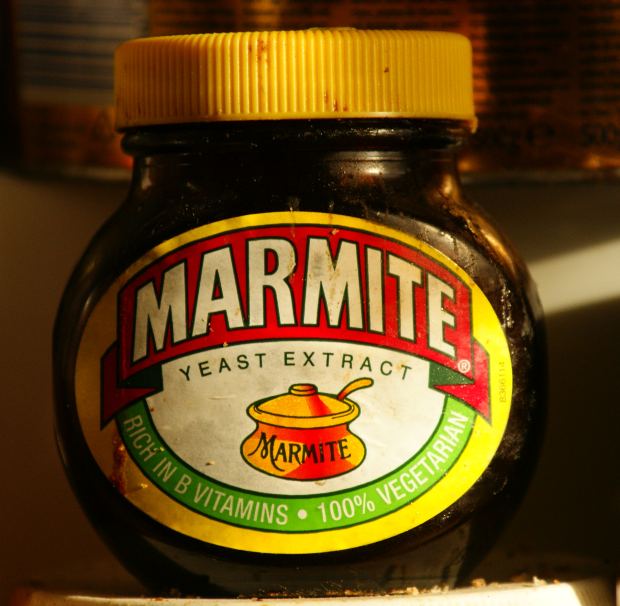
3rd January: Marmite

Today is Marmite's 114th anniversary. Love it or hate it, here are the facts:

  1. Marmite was invented in the late 19th century by German scientist Justus von Liebig who discovered that brewer's yeast could be concentrated, bottled and eaten.
  2. The first Marmite factory started production in Burton upon Trent, Staffordshire, with the yeast needed for the paste supplied by Bass Brewery. By 1907, the product had become successful enough to warrant construction of a second factory at Camberwell Green in London. Today, in Burton upon Trent, there is a £15,000 sculpture of a Marmite jar, nick-named Monumite.
  3. The name Marmite comes from a type of traditional casserole dish from France. It is this which is pictured on the standard British Marmite jar. The jars are similar in shape to the dishes, as well, and up until the 1920s Marmite came in earthenware pots.
  4. In Britain the product has traditionally been available in 2, 4, 8 and 16 oz jars.
  5. In 2009 a thief stole 18 jars from a petrol station in a month. In the end, the owner had to stop stocking it. It would have been bad news for the thief if he had been caught and sent to prison, because in the same year, Marmite was reportedly banned in prisons because inmates had been using it to create an alcoholic drink called Marmite Mule.
  6. Some claim that if you put a blob of Marmite on a plate and repeatedly tap it with a spoon, it turns white – or at least lighter in colour, because the Marmite becomes full of tiny bubbles.
  7. Marmite is known for being something people either love or hate, and it has become synonymous with something that polarises public opinion. Surveys in the UK have shown that 33% of Brits love it while 33% hate it - so in actual fact, 34% don't really care either way. People who hate it include Russell Brand, Madonna and Chelsea striker Nicolas Anelka, who has never actually tried it, because he has a phobia of it. Marmite lovers include Britney Spears, Eddie Redmayne, The Rolling Stones, and Dido.
  8. In Sri Lanka, hot Marmite is used as a hangover cure. Marmite is dissolved in boiling water and some lime juice and a fried, sliced onion added.
  9. Marmite was included as part of a soldier's rations in both world wars.
  10. In 2012, there was a Marmite shortage in New Zealand when the one Marmite factory there had to close after the 2011 earthquake made its cooling tower unsafe. There was panic buying in supermarkets and Marmite became known as "Black gold." The crisis itself was nicknamed "Marmageddon".


Saturday, 2 January 2016

January 2nd: Feast Day of St Basil the Great

Today is the feast Day of St Basil the Great. 10 facts about this saint.

  1. Well, it is his feast day for some. January 2 is his feast day in the Roman Calendar, and for the Church of England, but other churches observe it on different dates. Eastern Orthodox Church celebrates it on January 1, the Episcopal Church and the Anglican Church of Canada celebrate it on June 14. The Macedonian Orthodox Church celebrates Saint Basil's feast on January 14.
  2. So who was this guy, then? He was the Greek bishop of Caesarea Mazaca in Cappadocia, Asia Minor (modern-day Turkey), and an influential theologian who supported the Nicene Creed and opposed the heresies of the early Christian church.
  3. He was widely known for providing for the poor - he came from a rich family but gave all his possessions to the poor. He also personally organised a soup kitchen, and actively worked to reform thieves and prostitutes.
  4. He had a whole town built, near Caesarea, which included homes, a poorhouse, a hospital, a church and a hostel for travellers. It had a staff of medical professionals and artisans, and was large enough to be given a name - Basiliad.
  5. He was given the title of Doctor of the Church and is known for the writings he left behind which include guidelines for monastic life which focus on community life, liturgical prayer, and manual labour, letters and sermons. Other titles include Great Hierarch, revealer of heavenly mysteries and he is one of the Cappadocian Fathers along with Gregory of Nazianzus, and Gregory of Nyssa.
  6. Gregory of Nazianzus was a close friend of his, who he met at school. They studied together after school, in Athens, where they met a fellow student who would become the emperor Julian the Apostate.
  7. Basil came from a family of saints. His maternal grandfather was a Christian martyr and his siblings, Macrina the Younger, Naucratius, Peter of Sebaste and Gregory of Nyssa are also saints.
  8. St. Basil is depicted in icons as thin and ascetic with a long, tapering black Beard, often with a dove or heavenly hand giving him a pen.
  9. He is patron of Russia, Cappadocia, Hospital administrators, Reformers, Monks, Education, Exorcism and Liturgists.
  10. He's the Greek Father Christmas, bringing gifts to children on his feast day (which is January 1 in Greece). It is traditional on St Basil's Day to serve rich Bread baked with a coin inside, and to visit the homes of friends and relatives, sing New Year's carols, and to set an extra place at the table for Saint Basil.

Friday, 1 January 2016

January 1st: Beginnings

It's the beginning of a new year, so here are ten quotes about beginnings. Happy New Year.

  1. The beginning is the most important part of the work. Plato
  2. Every new beginning comes from some other beginning's end. Seneca
  3. Imagination is the beginning of creation. You imagine what you desire, you will what you imagine and at last you create what you will. George Bernard Shaw
  4. There must be a beginning of any great matter, but the continuing unto the end until it be thoroughly finished yields the true glory. Francis Drake
  5. Time has no divisions to mark its passage, there is never a thunder-storm or blare of trumpets to announce the beginning of a new month or year. Even when a new century begins it is only we mortals who ring bells and fire off pistols. Thomas Mann
  6. There will come a time when you believe everything is finished. Yet that will be the beginning. Louis L'Amour
  7. Much as we may wish to make a new beginning, some part of us resists doing so as though we were making the first step toward disaster. William Throsby Bridges
  8. In every phenomenon the beginning remains always the most notable moment. Thomas Carlyle
  9. Remember tonight... for it is the beginning of always. Dante Alighieri
  10. In the beginning, there was nothing, and then God said, “Let there be light.” And there was. There was still nothing, but at least you could see it. Ellen DeGeneres